
AI SEO vs. Human Content: What Drives Rankings & Traffic?
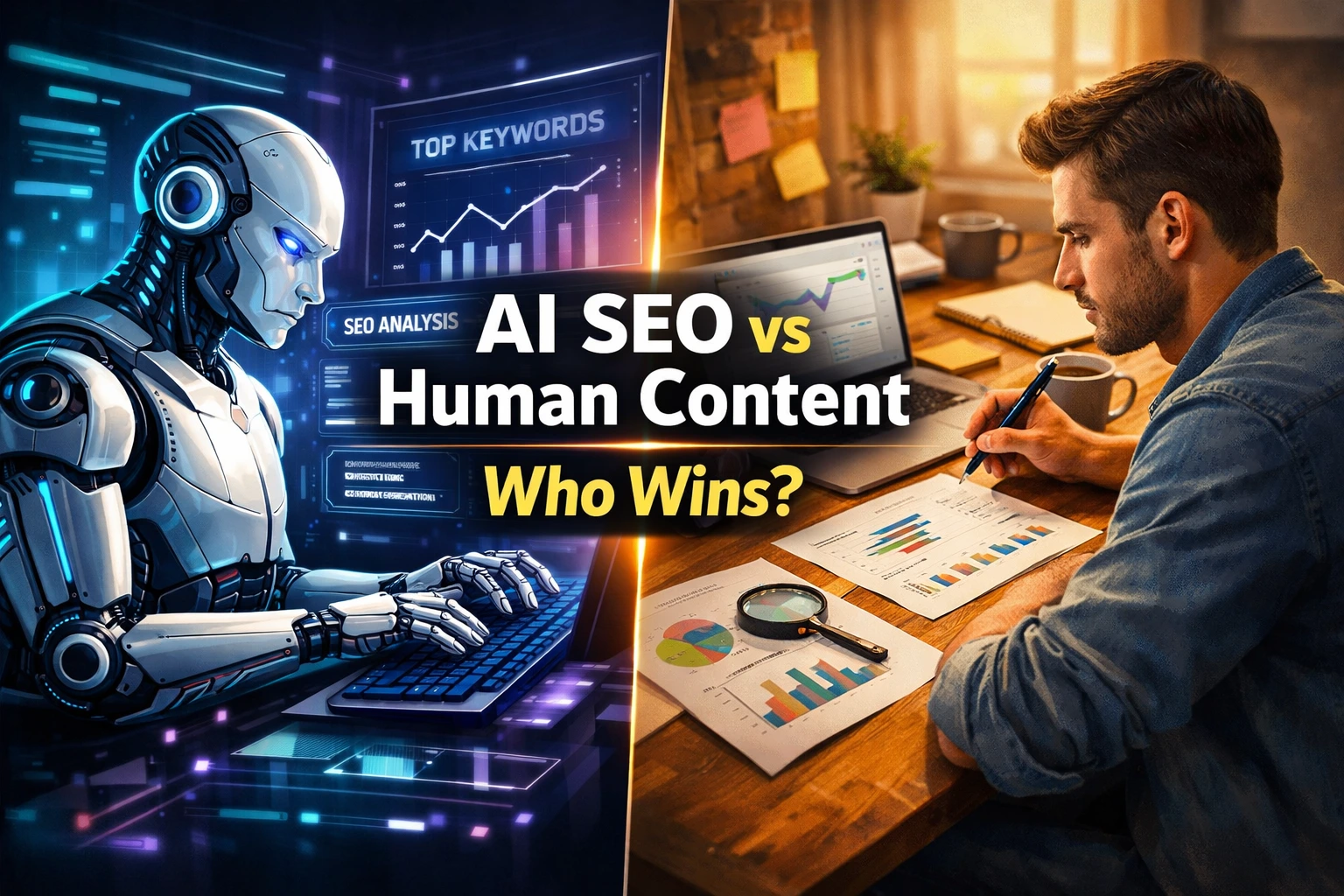
Table of Contents
What if we told you that your biggest SEO rival is a tireless algorithm, not a company?
It is no longer an experiment; AI-generated content is real. It’s ranking, scaling, and changing the way businesses use AI SEO. Blogs, landing pages and even long-form content are being written in minutes, not weeks, and in some cases, they outrank human-written content.
However, it’s not just about speed, because it isn’t the only winning factor in SEO.
Search engines are becoming increasingly intelligent, and users are becoming more selective. Google still rewards content that feels real, useful, and trustworthy. The real question isn’t whether AI can write, but whether it can establish trust, authority, and long-term traffic comparable to human-written content.
Let’s examine where AI excels over humans and where humans surpass AI. We will also discuss how the future of SEO does not belong exclusively to either AI or human content, yet both play a significant role!
What is Human Content vs. AI Content?
Machine learning models, trained on vast amounts of existing data from online platforms, create AI-generated content. These tools take patterns, keywords, and structure and create blog posts, landing pages, and SEO copies at scale. For many brands, this type of content has become an integral part of their efforts in AI SEO optimization.
Content created by humans, in contrast, stems from a mix of experience, judgement and intention. It is based on actual knowledge and opinion, rather than simply patterns extracted from the Web.
Example: Using an AI tool, you can generate 20 search engine-optimized blog posts targeting various forms of the keyword in one afternoon. Each article is structured correctly, keyword-rich, and of high technical quality, but they all sound alike, based on the same rudimentary framework.
A human might only write one long article based on real client data that explained what worked (tools) to improve rankings and what didn’t work and why. That post gains backlinks, ranks for several long-tail keywords, and continues to attract visitors months later.
How Search Engine Perceives Content Quality?
Google doesn’t rank content based on whether AI or humans wrote it; it ranks content based on its usefulness. Its systems promote pages that have Experience, Expertise, Authoritativeness and Trustworthiness (E-E-A-T). AI-generated content is not penalised by default, but it will need to meet these standards. Content that is generic, repeated, and unoriginal is often ineffective over the long term. For AI SEO to be successful, content must provide real value to the user, align with clear user intent, and offer credible insights – automation will not be the answer.
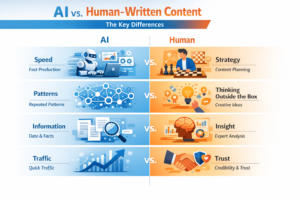
AI vs. Human-Written Content: The Key Differences
1. Speed vs. Strategy
The biggest advantage of AI is its speed. It’s able to generate hundreds of SEO-friendly articles in the time that it takes a human to write one. That’s why several large websites and AI SEO services are leveraging AI to enhance their content production capabilities.
Humans, however, bring strategy to the table. They understand the purpose of content, who it is intended for, and how it aligns with a broader SEO objective.
2. Patterns vs. Thinking Out of the Box
AI is proficient at recognizing patterns across highly ranked pages. Humans are adept at breaking these patterns. Original ideas, contrary opinions, and unique insight are still very much human territory and a sure way to gain backlinks and authority.
3. Information vs. Insight
AI can summarize information effectively, but it does not fully understand the context of specific industries or niches. Human writers can understand trends, explain their implications, and tailor content to meet users’ needs, especially in competitive or specialized sectors; this distinction is crucial for effective strategic planning.
4. Traffic vs. Trust
AI-generated content may generate traffic quickly, but human-written content fosters trust and credibility. Engagement metrics, such as time on page, return visits, and conversions, see drastic improvements with content that feels authentic and experience-driven. These can enhance overall AI SEO performance when used wisely in conjunction with each other.
The Hybrid Approach: the Best of Both Worlds
In this field, real winners emerge, particularly when the capabilities of AI and Humans are combined. It’s not about choosing one over the other but about how well they work together.
AI tools are great for finding keywords, analyzing SERPs, organizing topics, creating outlines, and writing first drafts. They make AI SEO optimization faster, more flexible and data-driven.
Then, humans enhance the content with their knowledge, making it easier to understand, correcting misunderstandings, managing the brand voice, and aligning with search intent. This human layer is responsible for transforming AI output into content that works effectively.
That’s why modern AI SEO services are inclined towards a workflow that combines both. Not fully automated or manual-only, but rather a planned team effort. If you use AI wisely, you can grow and maintain quality and trust.
Future Trends: What Can You Expect from AI Content Writing Tools?
As we all know, the rapid development of AI content tools has statistically proven to be significant.
- In 2026, 90% of online content will be AI-aided in some capacity.
- AI tools will prioritize intent and the semantic relevance of a search over just keywords.
- Better integration with AI SEO optimization platforms, with internal linking and content updates
- Increasing demand for human editors and editorial experts to ensure originality and trust
- Over 90% of SEO professionals say AI makes them more efficient, but does not replace human strategy
- Google anticipated having even more of a focus on firsthand experience and authenticity.
- Hybrid AI-human workflows are becoming the standard of the AI SEO services industry.
Conclusion
The debate is no longer really about AI vs. human content – it’s about “who’s getting AI right?”
AI can assist you with publishing quickly, but it won’t build authority for itself. Without the tools, human touch can’t create the trust you need. The most powerful AI SEO strategies will be a combination of both to create content that ranks today and remains relevant tomorrow, too.
In this highly competitive digital landscape, AI is not a shortcut but a multiplier. When used strategically, it can transform good content into high-performing content that attracts traffic and drives long-term growth.
Experience creates value. Even so, in the race between AI and human content, the real winner is creative strategy. 1702 Digital helps you combine speed, insight, and authenticity to build a balanced approach that truly works.
1702 Digital helps brands win with AI SEO by strategically blending AI-driven automation with human-led expertise, enabling faster content scaling without compromising trust, rankings, or conversions; through AI-assisted keyword research, SERP and AI Overview optimization, E-E-A-T–focused content strategies, technical SEO, and human-edited, industry-specific content writing services, we ensure every piece is original, intent-driven, and built to perform today while remaining resilient to future algorithm updates.
FAQs about AI vs Human Written Content
1. Does AI-generated content rank on Google?
Yes, AI-generated content can rank on Google if it provides genuine value, matches search intent, and meets Google’s E-E-A-T standards. Google does not penalize AI content by default. However, thin, repetitive, or unhelpful AI content may fail to perform in the long term.
2. Is AI content bad for SEO?
AI content is not bad for SEO when used correctly. It becomes problematic only when it is mass-produced, generic, or lacks originality. AI works best when combined with human editing, real expertise, and strategic optimization to ensure accuracy, trust, and relevance.
3. What is the difference between AI SEO content and human-written content?
AI SEO content focuses on speed, scalability, and pattern-based optimization, while human-written content adds experience, insight, and originality. AI excels at drafting and keyword targeting, but humans are essential for building authority, trust, and long-term organic performance.
4. Does Google penalize AI-written content?
No, Google does not penalize content simply because it is written by AI. Google evaluates content based on usefulness, originality, and trustworthiness. Content that fails to help users—whether written by AI or humans—may struggle to rank.
5. Can AI content replace human writers for SEO?
AI cannot fully replace human writers for SEO. While AI improves efficiency and scale, humans are needed for strategy, context, experience, and editorial judgement. The most successful SEO strategies use a hybrid AI-human workflow.
6. Which content performs better: AI or human-written?
Human-written content typically performs better for competitive, high-intent keywords due to trust and engagement. AI content can perform well for informational or long-tail queries when refined by human editors. A blended approach delivers the strongest overall SEO results.
7. How does AI SEO help increase website traffic?
AI SEO helps increase traffic by identifying keyword opportunities, analyzing SERPs, creating scalable content drafts, and improving content structure. When combined with human optimization, it accelerates publishing while maintaining quality and search performance.
8. What is the future of AI SEO content?
The future of AI SEO content lies in hybrid workflows. AI will handle research, drafts, and optimization, while humans will ensure originality, strategy, and trust. By 2026, most high-performing content will be AI-assisted but human-led.
Like What You Read?
Have an Idea and Want to Build Something Together? Contact Us Now
How to Optimize Content for AI Search: A Complete AEO & GEO Framework
Search has no longer been the same. It has completely changed. For instance, AI search engines such as Google AI…
Read more →
How to Build Brand Authority for AI Search Engines: 5 Proven Strategies
AI-powered search is completely altering how brands get found, and now being seen as trustworthy matters most. This blog explains:…
Read more →
Technical Content Writing Explained: Benefits, Examples & Best Practices
Technical content writing helps convey information to its intended recipients effectively. It helps businesses communicate clearly, improve user experience, and…
Read more →