
Competitive Analysis Explained: Framework, Format, and Examples
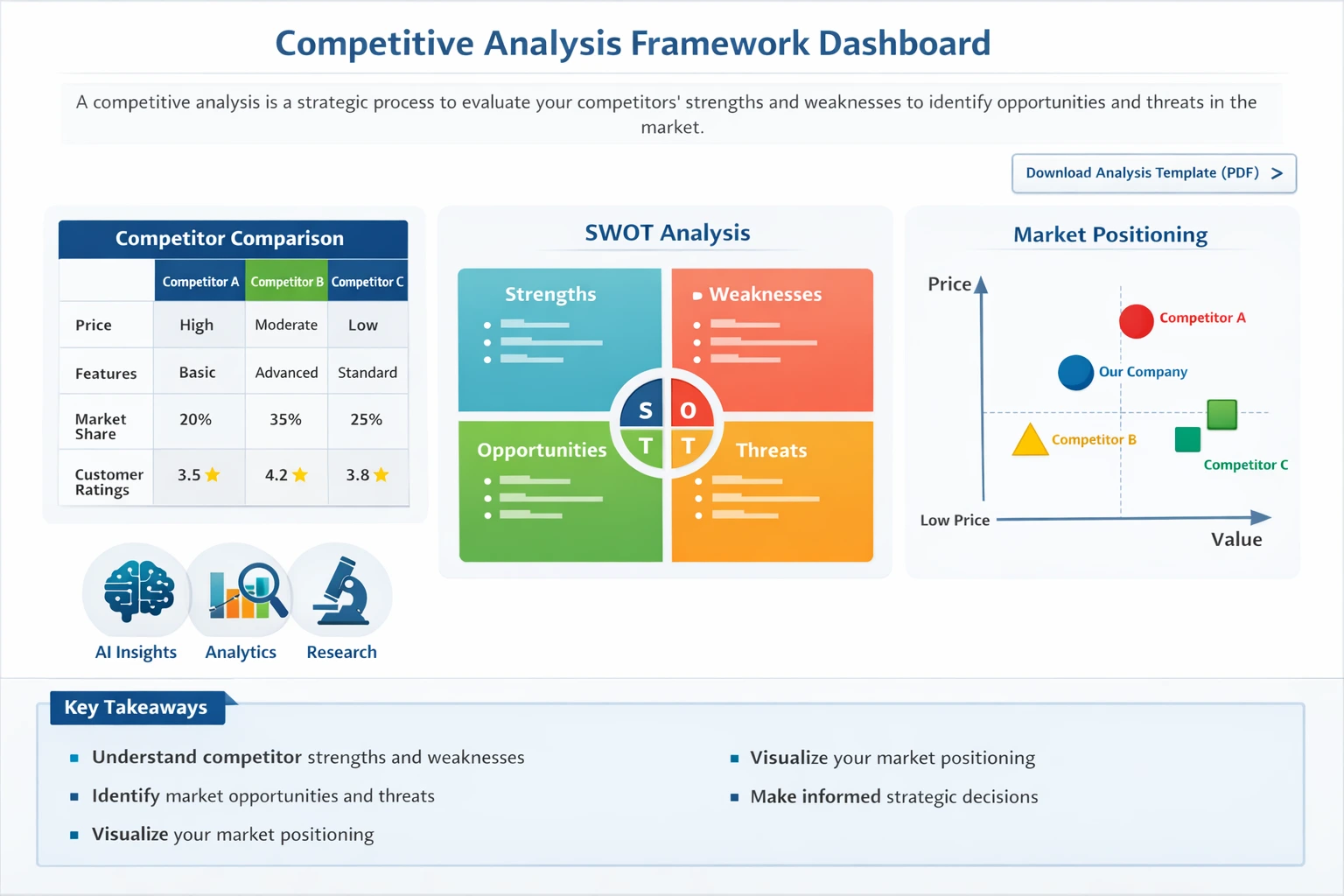
Table of Contents
Understanding the competitive landscape is a core requirement for informed business decision-making. Through a competitive analysis, you will be able to assess your own products, marketing approaches, and overall presence in the industry and see how you stack up against both direct and indirect competition using systematic, fact-based methods.
This article outlines how to conduct a competitive analysis and demonstrates how insights can be documented in a practical report using recognized frameworks and formats. HubSpot’s 2026 State of Marketing report indicates that 61% of marketers consider AI the most significant disruption in marketing over the past two decades. The report also states that 80% of marketers employ AI for content creation, while 75% leverage it for media production.
What Is Competitive Analysis?
Competitive analysis is the structured process of identifying competitors and evaluating their products, pricing, positioning, marketing, and customer experience. The objective is to understand how competing organizations operate, where they perform well, and where gaps exist in the market.
- Strategic planning and positioning decisions
- Product or service differentiation
- Pricing and value proposition assessment
- Risk identification and opportunity discovery
A Step-by-Step Approach to Competitive Analysis
A reliable method requires a repeatable structure. Organizations typically use a standardized competitive analysis format to assess competitors’ offerings.
1. Select a Standard Competitive Analysis Template
Using a consistent competitive analysis format improves clarity and comparability. A template for conducting a competitive analysis may include:
- Competitor name and category
- Product or service overview
- Pricing and plans
- Key features and exclusions
- Marketing channels
- Sales approach
- Customer feedback summary
- Strengths, weaknesses, and gaps
2. Identify Direct and Indirect Competitors
There are basically three kinds of competing businesses:
- Direct competitors: Companies which compete directly with you by providing similar products or services to the exact audience.
- Indirect competitors: Competitors who offer similar solutions using different means are referred to as indirect competitors.
- Emerging competitors: Newly developed entry-level companies are categorized as emerging competitors with scalable or disruptive business models.
3. Analyse Products or Services
Product analysis focuses on functional and operational attributes rather than marketing claims. Key areas include:
- Core characteristics and operational limitations
- Coverage or scope of service
- Pricing and possible add-on charges
- Compliance with regulations
- Technology or delivery model
4. Review Marketing Channels and Content Formats
The objective of the marketing analysis is to understand how competitors are developing and communicating with their customers through the evaluation of their marketing and sales processes. This includes:
- Primary traffic sources (search, paid media, referrals)
- Content formats (blogs, guides, videos, tools)
- Messaging focus (pricing, features, education)
5. Assess Sales and Distribution Processes
Sales analysis evaluates how offerings are purchased or accessed. Common parameters include:
- Online versus assisted sales
- Lead qualification process
- Turnaround time and documentation requirements
- Post-purchase support mechanisms
6. Study Customer Feedback and Reviews
Customer feedback gives you a real example of how products are performing. Some good places to find customer feedback used as evidence in this process would be:
- Google Reviews
- Trust Pilot
- App Store Reviews
- Industry discussion forum
7. Evaluate Strengths and Weaknesses
Comparative analysis of your competitors allows for a more objective evaluation of your competitors. The purpose of this activity is not to make any assumptions; rather, it is to provide factual evidence for determining strengths & weaknesses.
8. Define Market Positioning
In the last step, you will take all facts and determine how you compare to other providers on the following measures: price, coverage, service depth, or technology enablement. This step completes the competitive analysis framework.
Competitive Analysis Example: Step-by-Step Breakdown
1. Identifying Competitors
A hypothetical insurance platform may identify three direct digital insurers and two aggregator platforms based on search visibility and product overlap.
2. Product Strategy Analysis
| Parameter | Competitor A | Competitor B | Competitor C |
| Product Range | Motor only | Motor + Health | Motor + Travel |
| Customisation | Limited | Moderate | High |
| Regulatory Disclosure | Available | Available | Partial |
3. Marketing Strategy Analysis
- Competitor A relies primarily on paid search
- Competitor B focuses on educational blogs and tools
- Competitor C leverages partnerships and referrals
4. Sales Strategy Analysis
- Fully online purchase flows reduce processing time
- Assisted sales increase conversion for complex products
5. Feedback Analysis
Common feedback patterns may include:
- Delays in claim settlement
- Limited policy transparency
- Inconsistent customer support availability
6. Determining Positioning
Based on documented gaps, the organisation may position itself around transparency, faster documentation, or broader coverage options.
Creating a Competitive Analysis Report
A final report consolidates findings into a clear, decision-ready document. A typical competitive analysis contains:
- Executive summary
- Competitor comparison tables
- Key insights and risks
- Identified gaps and opportunities
- Data sources and references
Conclusion
An organized structure allows the reader to understand exactly how they should perform a Proper Competitive Analysis in a clear and unbiased manner. When conducted using verified data with consistent templates and established research tools, a Competitive Analysis will result in making informed business decisions as opposed to assumptions.
Organizations that regularly update their Competitor Profile will respond more quickly to changing customer expectations, regulatory requirements, and marketplace fluctuations.
However, conducting an effective competitive landscape analysis requires more than surface-level research. It demands data-driven insights, SEO intelligence, performance benchmarking, and ongoing monitoring.
At 1702 Digital, we specialize in SEO-driven competitive analysis, digital strategy consulting, and performance marketing solutions that help brands outperform direct and indirect competitors. Our SEO services include:
-
Advanced competitor benchmarking
-
Keyword gap and content opportunity analysis
-
SEO strategy development
-
Technical SEO audits
-
Market positioning and digital growth planning
By combining structured competitive analysis frameworks with AI-powered marketing insights, 1702 Digital helps businesses build sustainable visibility, improve conversion performance, and gain measurable competitive advantage.
If you’re looking to strengthen your market position and build a data-backed growth strategy, our team can help you transform competitive insights into scalable results.
Also Read – Latest SEO Trends: Dominate Google Rankings in 2026
What’s Generative Engine Optimisation (GEO) & How To Do It?
FAQs
1. What is competitive analysis used for?
Competitive analysis is used to evaluate competitors’ products, pricing, marketing, and positioning. It helps organisations identify market gaps, assess risks, and make informed strategic decisions based on evidence.
2. How often should a competitive analysis be conducted?
A competitive analysis should be reviewed at least once or twice a year. More frequent updates may be required in fast-changing markets or when new competitors enter the space.
3. What information is included in a competitive analysis?
It typically includes competitor profiles, product or service comparisons, pricing structures, marketing channels, sales processes, and customer feedback. Data is sourced from public and verifiable platforms.
Like What You Read?
Have an Idea and Want to Build Something Together? Contact Us Now

4 Best SEO Plugins for WordPress in 2026
Fed up with trying to make your WordPress website stand out? Then you need the appropriate software kit. Although great…
Read more →
How Content Chunking Improves SEO, AI Visibility & User Experience?
The way content is structured has mattered for readability. But with AI-driven search now reshaping how information is discovered, structure…
Read more →
10 Best Shopify SEO Tools Every eCommerce Needs To Optimise The Store
There are challenges and tasks to take your Shopify store live and to rank it. With the number of online…
Read more →