
Shopify vs WooCommerce (2026): Complete Comparison for Online Store Success
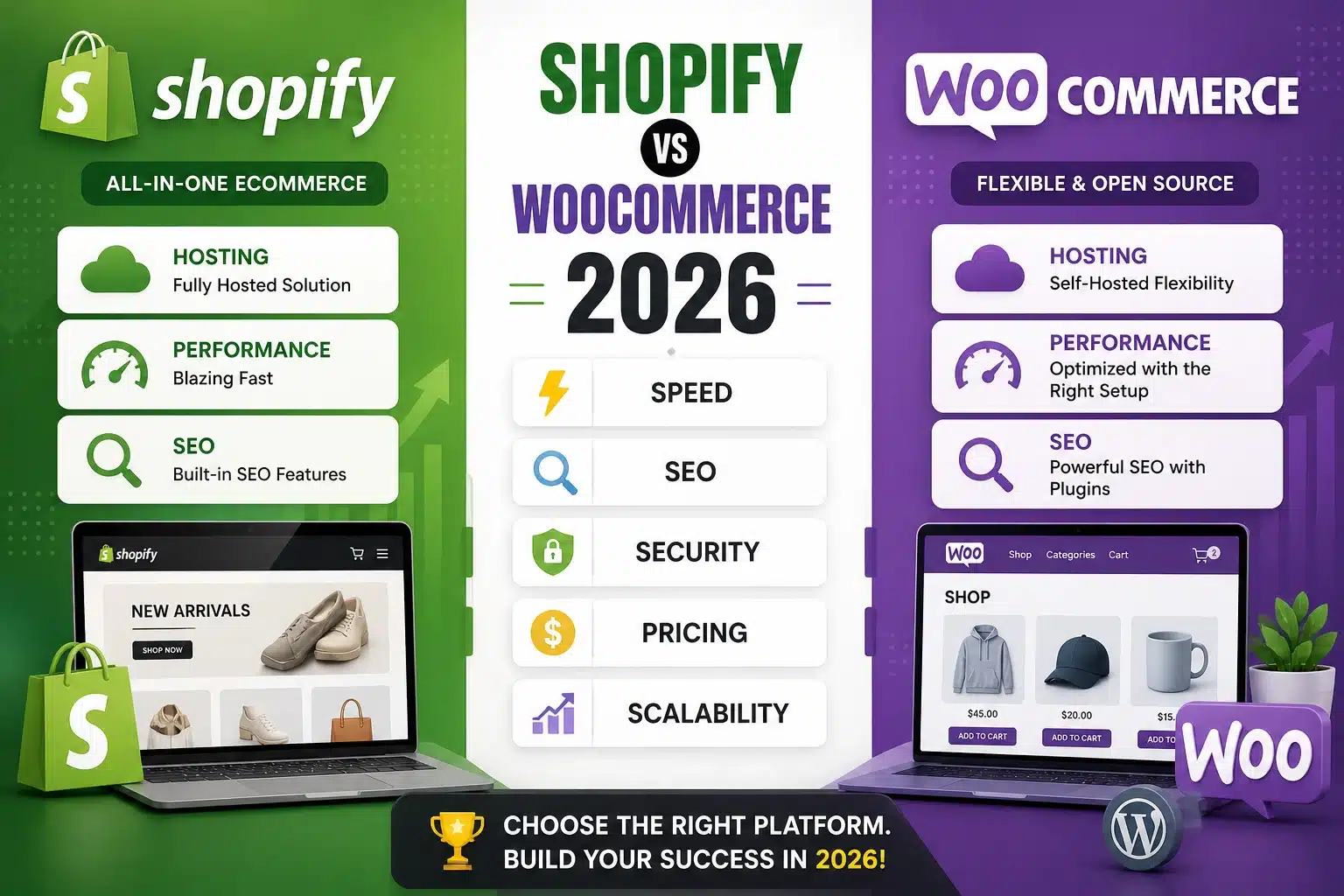
Table of Contents
Taking into account the problem of selecting the most appropriate eCommerce platform between Shopify and WooCommerce for your business in 2026, the following factors will assist you in determining the differences between both platforms, which include:
- The differences between Shopify and WooCommerce regarding their functionality and features
- The ability to perform, scale, and guarantee security for both platforms
- Whether either platform suits your requirements or aligns with your expertise
Fast loading webpages, personalising product recommendations, a smooth check-out process, and managing inventory dynamically are no longer a choice; instead, they are vital aspects of e-commerce. All successful eCommerce sites rely on a strong platform.
While in 2025, 7.2 million websites were using Shopify and over 6.7 million WooCommerce online stores globally (BuiltWith Trends, 2025), let’s not discuss popularity. Instead, we should think about the better choice for you in 2026.
Utility vs. Architecture: Philosophical Contrast in Their Development
The Fully Managed Utility: Shopify
Being a fully managed SaaS (Software-as-a-Service) platform, Shopify makes all processes simple for the merchant: there are no concerns about infrastructure, hosting or support, just pure business – selling stuff. This ‘plug-and-play’ principle of operation is great for those who need speed and user-friendliness.
The Open-Architecture System: WooCommerce
As it’s clear from the name, WooCommerce represents WordPress’s open architecture solution. It’s a plugin for WordPress that allows creating e-commerce sites with all the required functionalities. The difference between Shopify and WooCommerce lies in their open-source nature: it offers more freedom, but you need to put in more effort for optimisation.
Speed and Security of Infrastructure in 2026
Global Infrastructure with Built-In Edge and CDN: Shopify
Shopify leverages a global infrastructure using edge computing technology. According to information shared by Shopify developers, this platform can support more than 10,000 transactions per minute during peak traffic periods like Black Friday sales.
Hosting Resources That Provide Performance: WooCommerce
As previously stated, the performance of WooCommerce depends heavily on its hosting services. If using the best premium hosting services, such as Kinsta or WP Engine, WooCommerce can provide sub-2-second page loads. However, poor server configuration can significantly impact performance.
So, how do Shopify and WooCommerce compare on security and performance? Shopify provides stability, whereas WooCommerce provides possibilities (in case of optimal configurations).
Technical Debt and Ecosystem
Reviewed Marketplace for Apps: Shopify Apps
The Shopify apps marketplace comprises over 8,000 reviewed applications, ensuring compatibility and security. Although the technical debt is reduced here, there is little flexibility in this kind of ecosystem.
The Wild West: WordPress Plugins
WooCommerce supports integration with more than 60,000 plugins, which offer unmatched possibilities yet also cause more problems associated with plugin conflict and management.
SEO and Content Marketing Strategy
The Blogging King: WooCommerce (WordPress)
WooCommerce is an expert when it comes to creating advanced content and optimising it with a plethora of useful plugins.
Shopify SEO: The Built-In Method
Shopify has a number of built-in Shopify SEO features to boast, such as auto-generation of XML sitemaps, proper URL optimisation, and more. But compared with WordPress, Shopify lacks flexibility and customisation.
Thus, when comparing Shopify vs. WooCommerce (WordPress), we can conclude that WooCommerce wins the fight in the SEO category.
Security and Compliance Issues: Moat Protection
Platform-level Security: Shopify
Shopify ensures the following measures: PCI DSS Level 1 compliance, automatic updates, SSL certificate protection, and anti-fraud features. Thus, if you want to put less effort into managing your security issues, it will be better to opt for a Shopify development agency.
User-level Security: WooCommerce
In its turn, WooCommerce requires constant updates, protection, and backup. The merchant will have to do all of this manually. When it comes to the Shopify vs WooCommerce security comparison, one can say that Shopify is much more secure.
Ecosystem War: Extensions and Interoperability
Shopify’s Vetted API Economy
Shopify’s APIs allow for easy integration with CRMs, ERPs, marketing solutions, and other systems. This is additionally boosted by Shopify Plus.
WooCommerce Open-Source Repository
Open source code allows WooCommerce to have any functionality desired by a developer. However, it may come at a price of fragmentation.
A WooCommerce vs Shopify Plus comparison can be made in terms of interoperability for business purposes.
Technical Deep Dive: Headless Commerce Architecture
Shopify Hydrogen and Oxygen
The Hydrogen (React-based framework) and Oxygen (hosting layer) solutions allow developers of a Shopify development agency to build fast, headless shopfronts that facilitate dynamic app-like shopping experiences.
Decoupled WooCommerce Pattern
It supports headless deployments using a REST API and GraphQL. Nevertheless, coupling it with the latest generation of frameworks like Next.js requires higher levels of expertise among the developers.
Security of Websites by 2026: Preparation Against New Threats
Self-driving Attack
There is an increase in attacks through the use of AI. Shopify has made sure that it includes AI-powered fraud detection solutions for the purpose of mitigating attacks autonomously.
Supply Chain Attack
It is worth mentioning that sites operating through the latter platform are more vulnerable to attacks related to the supply chain, considering there is room for plugin flaws.
It becomes crucial to comprehend the differences when it comes to Shopify vs. WooCommerce security comparisons.
Sustainability of Digital Platforms and Their Environmental Impact
Carbon Efficiency of Managed SaaS
Centralised architecture at Shopify ensures energy-efficient operations per transaction, thus minimising the carbon footprint.
Self-Hosted Merchant’s Responsibility
While WooCommerce merchants rely on self-hosted environments, they are responsible for selecting sustainable hosting services.
Ready to Build for 2026?
For Shopify vs WooCommerce (WordPress), it comes down to personal preference and priority:
Go with Shopify for ease-of-use, scalability, and managed services.
Go with WooCommerce for flexibility, customisability, and content-centric growth.
The Future of E-Commerce: Agentic Workflows
API-First or Theme-First
Shopify is becoming increasingly API-first and allowing for automated workflows with APIs.
Open Source Ecosystem Interoperability
WooCommerce needs to solve interoperability issues due to increasing complexity within the ecosystems.
The gap between the two platforms will be driven by automation capabilities and ecosystem interoperability in the coming years.
Partner with Experts for Scalable Growth
However, if you want to build a new shop or move your current one, contact 1702 Digital. Our services will help you customise and optimise your shopfronts and successfully migrate to the latest trends based on effective approaches. However, if your catalogue is enormous, you might require expert help.
Frequently Asked Questions
1: Can I move my products from WooCommerce to Shopify easily?
Yes, using Cart2Cart and Shopify’s import feature makes it quite simple. However, if your catalogue is enormous, you might require expert help.
2: Is Shopify truly that user-friendly?
Yes, it certainly is. Shopify takes away the hassle of setting up everything, making it a great option for beginners when it comes to Shopify vs. WooCommerce (WordPress).
3: Can I get a similar blogging experience on Shopify compared to WordPress?
Blogging can be done using Shopify, but it does not offer the same level of customisations and SEO capabilities as WordPress.
4: Which platform will serve me well for international sales?
Shopify is ideal for such purposes since it comes equipped with multi-currency options and other tools that facilitate global sales, especially Shopify Plus.
5: Which e-Commerce platform will give me an edge in SEO?
This largely depends on your goals. If you intend to optimise your content for search engines, WooCommerce is preferable, or you can also contact a professional Shopify development agency.
Like What You Read?
Have an Idea and Want to Build Something Together? Contact Us Now

Best Web Development Languages to Learn in 2026
Summary: Worried about which web development language is the best to learn first? This guide discusses: What are front-end languages…
Read more →
How 1702 Digital created a winning E-commerce solution NG EarSafe with Shopify
Web Development – How 1702 Digital created a winning E-commerce solution NG EarSafe with Shopify How 1702 Digital created a…
Read more →
1702 Digital and Ritebite Max Protein combine to achieve E-commerce Success
Web Development – 1702 Digital and Ritebite Max Protein combine to achieve E-commerce Success 1702 Digital and Ritebite Max Protein…
Read more →