
Best Web Development Languages to Learn in 2026
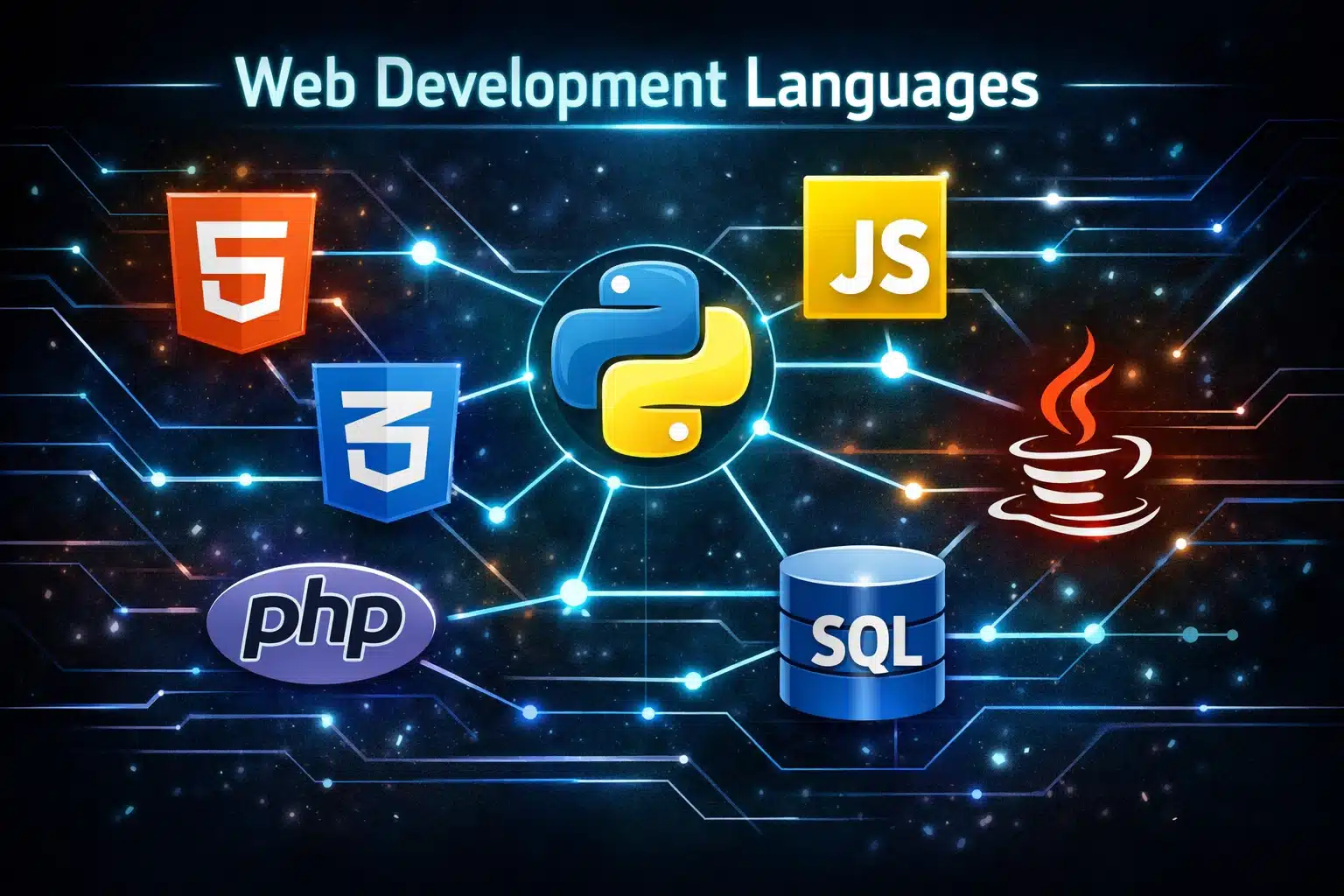
Table of Contents
Summary:
Worried about which web development language is the best to learn first? This guide discusses:
- What are front-end languages and back-end languages
- Which languages will be highly sought after in 2026
- And which language is the best fit for your website development goals?
A website loading time under a second, images falling into place instantly, a chat widget addressing you by name, and the page already knowing what you are searching for. None of these is a coincidence. Each one of those instances is enabled by one or many web development languages.
Globally, 1.9 billion websites are live; the difference between the website that converts and the one that is abandoned in 3 seconds is written in code. The coding languages are not as intimidating as they seem, but understanding them is the first step. You don’t have to learn them all. You just need to know where to start, and that’s the purpose of this guide.
What Are Web Development Languages?
Web development languages refer to programming and markup languages used to develop websites and web applications. Through these languages, developers can create the structure, design and functionalities of a site. Normally, these languages can be categorised in two ways:
- Front-End Languages
Front-end languages are used for the presentation and user interaction on a website. These include layout, colour, animation, and other components used in the user interface.
- Back-End Languages
Back-end languages are used for server-side operations on a website. These include database operations, user validation, and other activities within a website’s applications.
All in all, these web development programming languages are used together to create a visually appealing, efficient website.
Most Common Web Development Programming Languages
1. HTML (HyperText Markup Language)
HTML is considered the backbone of all websites. It is one of the best languages for website development, helping create and display web pages in a visually pleasing way. It is used in almost all websites to create and display web pages in a visually pleasing way.
Although HTML is not considered a real programming language, it is one of the primary web design languages used to create web pages, as it is used in almost all web pages.
Some of the main purposes of HTML are:
- Building the layout of web pages
- Structuring text using headings and paragraphs
- Inserting images, videos, and other media
- Connecting pages through links
- Enhancing search engine readability
2. CSS (Cascading Style Sheets)
CSS dictates the way a website looks. HTML provides the skeleton of a page, and CSS decorates it with colours, fonts, layouts, and the spacing of various elements. As design heavily influences user experience, CSS ranks among the top web design programming languages widely adopted in modern development.
Programmers rely on CSS to:
- Decorate web page layouts and themes
- Manage fonts, colours, and backgrounds
- Design for mobile devices using responsive techniques
- Work on animations and other visual effects
- Improve overall user interface design
3. JavaScript
JavaScript is definitely one of the most powerful web development languages in use today. It can make the site interactive and dynamic, i.e., the site can react to user actions immediately.
If there were no JavaScript, websites would be much more static. That is why most web developers still consider it their best programming language for creating modern web applications.
JavaScript is frequently used for:
- Making interactive forms and buttons
- Adding sliders, pop-ups, and animations
- Updating web pages in real time
- Developing web applications and dashboards
- Improving user engagement overall
4. Python
Python has gained tremendous popularity among web developers lately. It’s simple yet powerful. Developers like it because, with frameworks like Django and Flask, they can code websites and applications quickly.
Many of the websites and applications we use every day are driven by data, plus some even require advanced processing, which is where Python comes in.
Python is generally used for:
- Producing web applications that can be easily scaled
- Developing APIs and backend systems
- Creating platforms based on data
- Incorporating features of artificial intelligence
- Automating the tasks done through the web
5. PHP
The server-side language PHP, which is open source, is used by the vast majority of websites. It is one of the great choices for developing interactive websites that require a database and content management system.
Despite the introduction of many more advanced technologies since then, PHP is still one of the most trusted and widely used web programming languages.
Developers use PHP for:
- Producing dynamic web pages
- Linking the web pages to their backend databases
- Developing content management systems
- Managing login and other authentication mechanisms
- Supporting popular platforms like WordPress
6. Java
Java has established a name for itself through its extraordinary performance, high security, and scalability. It is the language of choice for large company-level applications, which must have robust backend systems and dependable architecture, among other things.
Here is a list of platforms where Java can be used:
- Enterprise-level web applications
- Large-scale data management systems
- Secure financial service platforms
- High-traffic websites
- Backend services that can be scaled
7. SQL (Structured Query Language)
SQL is a web development language used for querying databases. It helps in storing, managing, and retrieving data from databases. It helps in managing the data that sites use at the back-end. Web applications, including e-commerce sites, online banking portals, and social media websites, need to interact with databases continuously. SQL enables developers to have smooth communication with these databases; it is a must-have skill along with other web development programming languages.
Developers often use SQL to:
- Store and fetch website data from databases
- Keep track of user info, for example, login details
- Modify and remove entries from database tables
- Work with extensive datasets used in web applications
- Provide support to backend systems in the current web development
Popular Web Languages Compared At A Glance
Deciding between popular web languages is not about which one is “best” but about which one best matches your project type, team skills, and performance needs.
According to Statista, the popularity of some web design languages among developers is approximately as follows:
- JavaScript-66%
- HTML/CSS: 61.9%
- SQL: 58.6%
- Python-57.9%
- Java: 29.4%
| Language | Purpose | Beginner-friendly? | Job Demand |
| JavaScript | Full-stack development and building interactive user interfaces | Yes | Very High |
| Python | Back-end development and AI-powered web applications | Yes | Very High |
| PHP | Creating CMS platforms and e-commerce websites | Moderate | High |
| HTML/CSS | Structuring webpages and designing responsive layouts | Yes | Very High |
| SQL | Managing databases and handling website data storage and retrieval | Moderate | High |
| Java | Building enterprise-level and large-scale backend systems | Moderate | High |
How To Choose The Best Language For Developing A Website?
On one hand, there are so many web development languages, and new frameworks keep appearing every year. On the other hand, the truth that seasoned developers hardly ever reveal to beginners is that the best language is the one that helps you to release a product.
Below are four questions which will help you decide:
- Is your project a content site or a web application? Content-heavy sites (blogs, portfolios, online stores) can be built easily with PHP/WordPress or a JavaScript-based static site generator. On the contrary, complex web applications require full-stack JavaScript or Python.
- How long do you have to finish the project? Ruby on Rails and Python/Django are excellent for rapid prototyping. If you want to launch in a few weeks, these frameworks will work best. However, if your first concern is scalability, then Go or a typed superset like TypeScript would be good choices.
- Will you work alone or with a team? Because JavaScript’s ecosystem is so enormous, any team member you hire will know it. TypeScript provides type safety that becomes increasingly valuable as codebases grow.
- What skills are most rewarded by the job market? If your main objective is to get a job, JavaScript + React and Python are two web design programming languages that are ranked as the most in-demand all over the world in job postings. Starting with them is a prudent choice.
Don’t just follow trends. First, understand the basics of programming languages for web development, like HTML, CSS, and JavaScript; these are the common languages used around the web. Then you can learn a server-side/back-end language according to your needs.
Conclusion
Jobs requiring web development skills have reached an all-time high, and the trend is expected to continue. Every web development coding language you learn enables you to create more complex projects, apply for better jobs, and finally turn a product idea into reality. Web development languages are most beneficial when considered as a group; once you learn one, you can easily learn the next. You don’t need to master a whole technology stack before trying. Select a programming language, develop a real-world project with it, and your skills will improve from there. That is how every highly skilled programmer has begun.
At the same time, turning an idea into a fully functional, high-performing website often requires more than just knowing the basics. This is where experienced teams like 1702 Digital can help bridging the gap between development, performance, and user experience to build websites that don’t just work, but actually convert. Whether you’re validating an idea or scaling an existing product, the right technical and strategic support can make a significant difference.
FAQs
1. How many types of programming languages are there?
There are four main types of web programming languages: procedural, object-oriented, functional, and scripting. The majority of web development languages fall into one or more of these categories, depending on how they’re used.
2. Which programming languages are most popular?
JavaScript, Python, and TypeScript are the three most widely used languages in web development today. JavaScript alone is responsible for the frontend experience on almost all websites on the internet.
3. What is the easiest programming language to learn?
The easiest programming language for new programmers to learn is HTML, as they can develop a webpage within a few hours. However, when it comes to programming languages, the easiest to learn for new programmers is Python.
4. Which programming languages are most in demand?
JavaScript and Python are the two most sought-after languages globally through job postings. TypeScript is also gaining rapid popularity as more companies adopt codebases that can scale and be maintained over time.
5. What language do most applications use?
Most web applications use JavaScript for front-end development, while the back-end can be Python, PHP, or Node.js. Mobile applications mostly use Swift for iOS and Kotlin for Android.
Like What You Read?
Have an Idea and Want to Build Something Together? Contact Us Now
Shopify vs WooCommerce (2026): Complete Comparison for Online Store Success
Taking into account the problem of selecting the most appropriate eCommerce platform between Shopify and WooCommerce for your business in…
Read more →
How 1702 Digital created a winning E-commerce solution NG EarSafe with Shopify
Web Development – How 1702 Digital created a winning E-commerce solution NG EarSafe with Shopify How 1702 Digital created a…
Read more →
1702 Digital and Ritebite Max Protein combine to achieve E-commerce Success
Web Development – 1702 Digital and Ritebite Max Protein combine to achieve E-commerce Success 1702 Digital and Ritebite Max Protein…
Read more →