A Guide for User Experience (UX) and its SEO Impacts in 2026
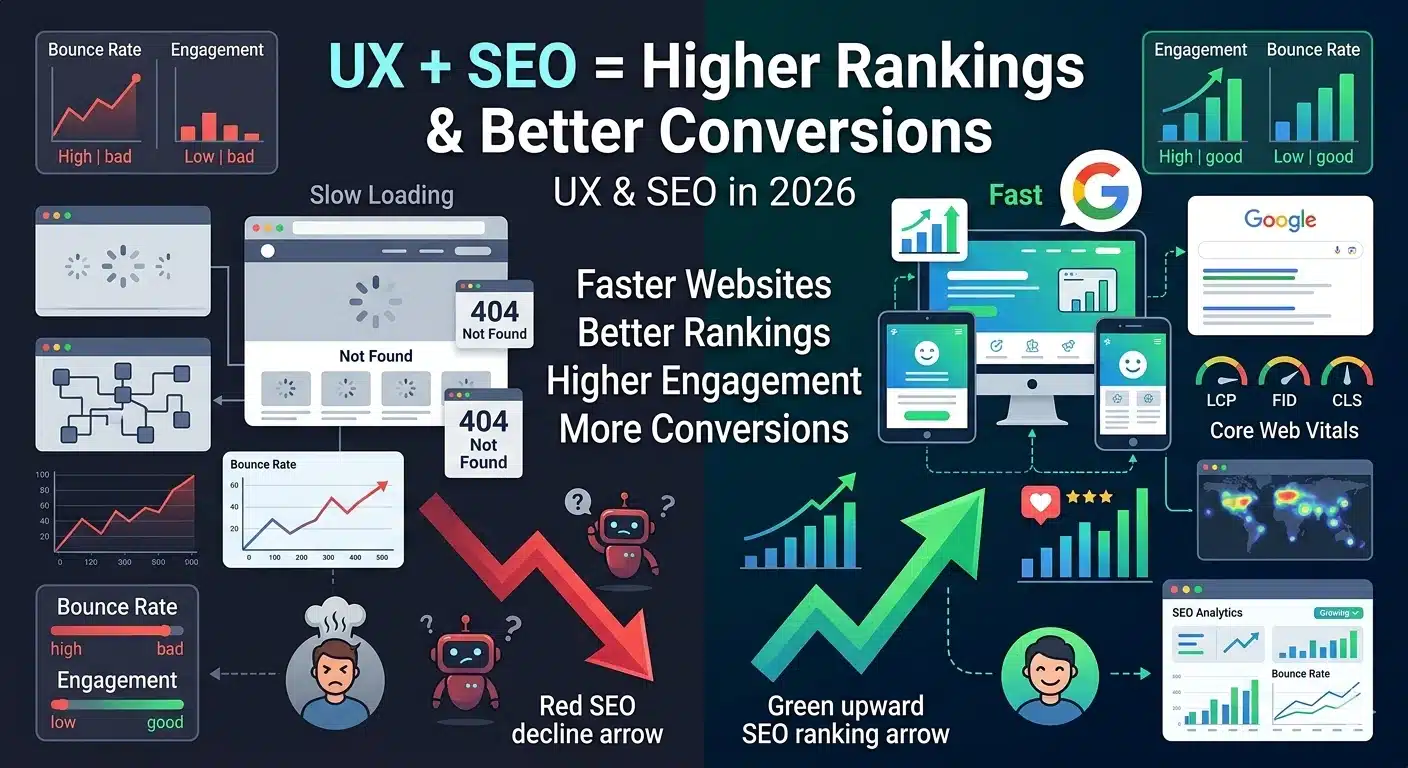
Table of Contents
User experience is no longer just an aspect of design; it is a key factor in improving search engine efficiency. The two factors, SEO and user experience, are closely linked, affecting website ranking and also visitor engagement. Your site needs to be smooth and fast for both user experience and rankings. Here is what you will learn from this blog post
- Why are user experience and SEO intrinsically linked today?
- Why does user behaviour play an important role in search rankings?
- The importance of Core Web Vitals
- Why readability matters in engaging users
- How UX affects SEO conversions
Imagine a time when you visited a website and left the platform quickly. More likely than not, this happened not because of a lack of relevance but because you didn’t enjoy what the site had to offer. The site may have loaded too slowly, or the design may have been confusing or unappealing.
The same thing applies when someone uses your website. Today, SEO largely relies on user behaviour and user experience, which means that the performance of your site will determine how well it ranks.
Why UX Now Shapes Google’s Definition of Helpful Content?
Google’s algorithm has changed, favouring brands that are really helpful to their users. But “the helpful” is not only the information in it but also the experience. The value of the content may be very high, but if people find it hard to access or it takes a long time to download, they may be unwilling to continue beyond its value.
This makes the point of how UX affects SEO and is now a major element of web design, and strongly influences ranking. Search engines like Google can identify the underlying factors that your users consider, e.g., page views, time spent on the page, etc., using analytical tools, and quantify them as signals of the level of user satisfaction with your content.
- A helpful site is one that:
- Quickly appears on each device
- Has user-friendly navigation
- Does not give information in a complex way
- Ensures smooth browsing
If one has all the elements mentioned, the content is more likely to rank well in search engines.
Users Decide Faster Than Ever
Online users are highly fickle, and it does not appear that this nature will change in the near future. It will only take a user a few seconds to evaluate a website, so they will decide whether to stay or leave. A website is cluttered, has a poor layout, and loads slowly, which could be why users leave immediately. If users’ behaviour toward the site is negative in any way, it will surely affect search engine signals.
For instance, you browse an e-commerce site looking for a product, but the page takes a long time to load. And when it finally opens, you find that the design is overcrowded and that you cannot easily locate the ‘Add to Cart’ button. What would you do? Of course, you will leave and not come back again. Eventually, the business loses its ranking and may end up on the third page of search engines.
This is a clear example of how UX affects SEO. The most notable examples of such factors are high bounce rates and low engagement, indicators of user dissatisfaction, which are among the critical features that can lead to a long-term reduction in your rankings.
To protect your prospects so that the user will stay on your website, you should provide:
- Clear, immediate understanding of your website
- Swift and quality performance
- Attractive and clean design
- Content that is easy to scan through
The easier it is for users to reach their desired outcome, the better your SEO performance will be.
The Core Web Vitals and Page Experience Are Mandatory
As a result, the Core Web Vitals should be taken seriously in modern SEO strategy development. It is important to note that these metrics are designed to measure real user experience and SEO effects through interactions with web pages. They consider the following features:
- Loading speed
- Interactive usability
- Stability of visual perception
If any of the above domains cause problems, it will create additional friction for users, potentially negatively affecting rankings. Therefore, improving technical issues becomes one of the mandatory SEO services in professional practice. It helps ensure a positive user experience when visiting a website, contributing to higher rankings.
The Readability, Structure, and Clarity Determine the Quality of Content for SEO
It is important to emphasise that content remains the core component of SEO and helps to improve search engine rankings. However, poorly formatted articles will not contribute to higher rankings, despite the usefulness of the information they present. The ability of users to perceive content is an essential feature of the user experience and SEO.
The following will improve the readability of your content:
- Short paragraphs
- Clear headings/subheadings
- Listed bullet points for important information
- Plain language
These components will help your readers scan your content faster and locate the necessary information more quickly, while spending more time on your site.
UX is Crucial for Your Conversions & Growth
Just getting traffic isn’t enough. Conversions drive your business forward, and UX significantly affects the number of them.
Should your potential customer get lost or confused while navigating your website, you won’t convert them into buyers.
An easy-to-navigate website creates trust and convinces users to engage. This is where the power of UX in SEO services comes from.
Bad UX may result in:
- Abandoned forms and shopping carts
- Decreased credibility of your company
- Loss of engagement opportunities
Good UX, on the other hand, means that your website will convert users successfully.
UX Defines SEO Success
Search engine optimisation is no longer just about visibility; it is now about providing users with the best experience. Today, user-centric websites are more likely to appear on the top search engine result pages.
Businesses are on the crest of the wave when they have:
- Fast-loading, responsive design
- Clear and engaging content
- Seamless navigation
- Mobile-first optimisation
At 1702 Digital, we are convinced that user experience is the foundation of every successful SEO strategy. Our tailor-made SEO services help you build a website that supports high rankings and delivers tangible benefits to the business.
FAQs
1. Is there any correlation between user experience and SEO ranking?
User experience determines users’ actions on your site, including how long they stay and how engaged they are. The search engine analyses such actions and ranks your website accordingly, proving once again how UX affects SEO ranking.
2. What particular parts of UX have more value for the SEO algorithm?
The aspects of how fast a page loads, its ability to adapt to mobile searches, the similarity to what was used, and how convenient it is to track needed information become essential to its ranking priority. If it is, indeed, what should be considered, then page rank and other outcomes depend only on how much users focus on them and on the search engine’s efficiency.
3. Does making UX user-oriented actually contribute to the increase in conversions?
Yes, a seamless user experience increases customers’ retention. It is a fact that the process of navigating and obtaining information is made clear, and the task is accomplished.
4. What is now the case with the UX and SEO situation?
A great user experience is the only way to survive in SEO now. Each method can deliver the best results when you combine technical SEO and user experience standards of excellence.
Like What You Read?
Have an Idea and Want to Build Something Together? Contact Us Now
4 Best SEO Plugins for WordPress in 2026
Fed up with trying to make your WordPress website stand out? Then you need the appropriate software kit. Although great…
Read more →
How Content Chunking Improves SEO, AI Visibility & User Experience?
The way content is structured has mattered for readability. But with AI-driven search now reshaping how information is discovered, structure…
Read more →
10 Best Shopify SEO Tools Every eCommerce Needs To Optimise The Store
There are challenges and tasks to take your Shopify store live and to rank it. With the number of online…
Read more →