
How to Optimize Content for AI Search: A Complete AEO & GEO Framework
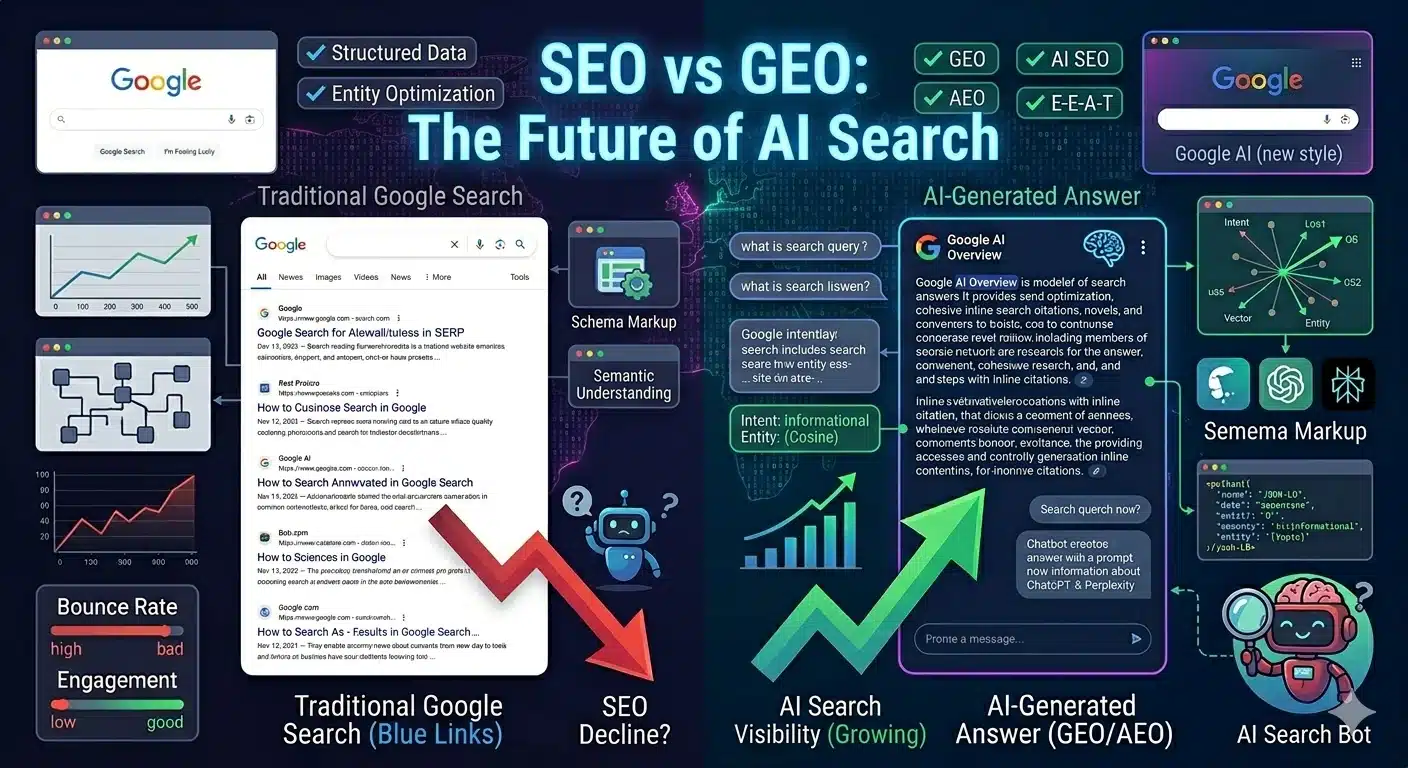
Table of Contents
Search has no longer been the same. It has completely changed. For instance, AI search engines such as Google AI Overviews, ChatGPT Search, and Perplexity don’t exist only to index your content; they now also create a summary, rewrite it, and even decide whether you are worth quoting. Traditional SEO was taking you to the first page. AI SEO will get you to the very answer itself. In this blog, we will discuss:
- What Generative Engine Optimisation (GEO) means and why it is important
- How AI search engines differ from traditional Google in ranking and document retrieval
- 10 actionable steps to align your content with the AI search of today
- Sub-forum strategies for Google, ChatGPT, Perplexity, and Gemini
- What parts of traditional SEO do the job now, and what should be dropped
At this moment, every time you ask a question to Google, an AI-generated response is likely to appear at the top, before any blue links and any ads.
Your page could be shortened to a single-sentence citation. Or you may not be mentioned at all.
This is not a routine algorithm change. It is a structural shift. Traditional SEO benefited from being in the top ranks. SEO now works the other way around, ensuring your content is referred to, trusted, and summarised by search engines. In this blog, we will discuss what generative engine optimisation is, how it differs from traditional SEO and how to optimise content for AI search.
Generative Engine Optimisation (GEO)
GEO is creating content in a way that AI models recognise as a reliable source to cite, not just for web crawlers. Previously, SEO involved seeking out links and PageRank. Now, GEO pursues semantic authority, which is hard to counterfeit. It’s all about being the AI’s first choice as an answer to a question.
Here’s the easiest way to tell the two apart. A typical search engine is asking, “Is this page really relevant and popular?” But an AI search engine is asking, “Is the source of the answer accurate, structured, and credible to be quoted?”
Also Read – Generative Engine Optimization
How AI Search Engines Actually Work?
AI search engines are not content crawlers and indexes. They read, interpret, and recreate data.
Here is an abridged description of the process. The crawler consumes your content. The embedding model creates semantic vectors out of it. As soon as a user poses a question, the model identifies the most relevant passages and generates an answer.
Notice what’s missing? Your URL. It’s optional. Your ideas, however, are not.
Your content must be quoteable. Short claims. Precise definitions. Straightforward facts. Since AI models are trained to avoid creating facts, they would always prioritise a clear statement over an extensive build-up to the same conclusion.
GEO vs Traditional SEO: What’s the Difference
| Factor | Conventional SEO | GEO/AI Search Optimisation |
| Objective | Rank in 1st position in search results pages (SERPs) | To be cited by AI responses |
| Core indicator | Backlinks and page authority | Semantic clarity & entity recognition |
| Content format | Keyword density and heading optimisation | Structured information, Q&A, and exact definitions |
| Performance indicators | Click-through rate (CTR) and ranking | Frequency of citation and mentions of your brand in AI responses |
| E-E-A-T | Important | Essential |
This change is not about beginning anew. While AI search optimisation relies on conventional SEO practices, some aspects of the past no longer apply.
What Can Be Considered Good For AI SEO
- E-E-A-T is still important
E-E-A-T is a fundamental principle of relevance for search engines. The acronym stands for Expertise, Authoritativeness, and Trustworthiness. The information that AI systems are trained on comes from human feedback that favours reliable content sources. Proof of the original author, a domain with a positive image, and duly cited materials can make it easier for AI to find you.
- Structured Data
By adding structured data to your page via a schema, you unlock AI parsers. Schemas such as the FAQ Schema, the HowTo Schema, and the Article Schema can be used where applicable. Even for organisations that provide Shopify SEO services via JSON-LD Apps, structured data will provide an advantage in AI retrieval for product and blog pages.
- Technical Details
Heavy, long-loading web pages are difficult for the AI engine to crawl. Clean code and fast load times remain baseline requirements.
10 Steps to Optimise Content for AI Search Engines
1. Beginning with the answer
Your point should be made very clear without going through all the details. AI models prefer when the content concludes first, then the explanations come.
2. Format the content as a Q&A
Organise the topmost parts as questions together with direct answers. This is how people ask queries with AI search engines, and this is how models find helpful materials.
3. Apply schema markups
Add FAQ, How-To, and Article schema. This kind of schema not only makes it easier for crawlers to understand but also makes AI Overviews available, allowing you to appear in AI search results.
4. Build overall authority, not just on individual pages
A single, well-optimised page alone is not enough. Present information in a cluster of supporting articles that solve the same problem. AI models prefer sources with deep, consistent expertise across a subject.
5. Cite Real Sources
Refer to the credible data. AI models tend to favour evidence-based facts even over unsupported ones.
6. Write for real question patterns
The number of natural language questions is increasing compared to regular keyword searches. For example, the most searched phrase, “the best running shoes”, has transformed into “What are the best running shoes for flat feet in 2025?” You have to write in a manner that is in harmony with the new search practice.
7. One single entity in all the sources
The same entity should be repeatedly named, described, and linked throughout the web. Therefore, do not focus on a single URL but on developing an understanding of entities – brands, people, and topics. If your information is inconsistent, you will not be viewed as a trustworthy source. Use different sources to properly optimise content for AI search.
8. Demonstrate your expertise on each page
Moreover, include your bio, list your credentials, and clearly state the publication date. The trustworthiness that arises from demonstrated genuine expertise is a prerequisite for those who offer AI SEO services or are professional advisors.
9. Make it a point always to update your content
Times change, and change never stops. If content sits idle for a long time, the trust signals it had will fade. You must make changes regularly so that AI knows your content is up to date and reliable.
10. Find the sources of your citations from AI
Track your AI citations. Use search tools like Brand24, Semrush, or SparkToro to stay informed whenever AI platforms mention your brand or content. Analyse what is getting cited and try to duplicate it.
Platform-specific Optimisation
Google AI Overviews
Getting ranked on the first page of results is no longer enough. Your content has to be extractable. That means you need clear paragraphs addressing specific queries, with high E-E-A-T.
- Include direct answers to queries at the start of each section
- Make sure the FAQs schema includes all question-answer pairs as separate entities
- Show off author information and “updated last” timestamps
- Blog content should be indexed separately from products when using the SEO service from Shopify
ChatGPT Search
ChatGPT searches are built on the Bing search index but use their own reasoning processes. It’s less about individual articles and more about your site’s overall reputation.
- Have a consistent online presence, not just on your website, but also on LinkedIn profiles and other industry sources.
- Write long-form content on different facets of the topic
- Choose conversational headlines that mirror how someone will phrase the question
- Have clean HTML code. Don’t gate any part of the content behind JavaScript
Perplexity Search
Perplexity explicitly identifies its sources. Scholars and professionals widely use it. ‘Cited in Perplexity’ is an excellent indicator of authority for AI searches.
- Publish unique research, data, or analysis that cannot be found elsewhere
- Highlight important statistics and findings clearly, pull quotes, bold numbers, and proper attribution
- Generate mentions from high-authority domains: trade press, academia, media outlets
- Craft specific queries. Perplexity works best when queries are highly detailed rather than general.
Gemini Search
Gemini uses Google’s Knowledge Graph extensively. Entity optimisation becomes even more crucial here.
- Keep Google My Business up to date; work toward Wikipedia or Wikidata recognition if feasible.
- Make sure all NAP information is consistent across the web
- Add structure to your organisation, products, and articles
- Connect similar content internally to form topical groups
The Bigger Picture
Simply put, AI-generated SEO actions and creating content for people are the same thing anymore. Optimising for AI search engines and generating really good content for humans are, at the moment, very much the same thing.
AI models are trained on human preferences. They are used to human search engine preferences for clarity, which they reward, and thus they, too, struggle for the same thing. Once upon a time, every trick in old-school SEO was a shortcut that deceived algorithms right away. It is very difficult to deceive an AI search easily.
According to Statista, the global AI in marketing market is expected to grow to more than $107 billion by 2028, up from $15.8 billion in 2021. Those companies that have now integrated AI search optimisation into their marketing strategy will keep that competitive advantage as the market grows.
Whether you are a person who guides a B2B content team, an e-commerce store owner who deals in Shopify SEO services, or a person who manages content on their own, the way ahead is the same. To know how AI models perceive your content, you have to learn about their workings. Writing for both humans and machines simultaneously is a must. This task can be done by reviewing the pages you have already published through the GEO lens and taking immediate action, as brands that act quickly leave others far behind every month.
FAQs
1. Does Traditional SEO Still Work for AI Search Optimisation?
Yes! Traditional SEO strategies will always form the backbone of any content that is intended to be discovered by AI-powered search engines. While it is essential to ensure the fundamentals are in place, they should also be accompanied by a clear understanding of what it means to create AI-friendly content.
2. How Long Does It Take to Appear in AI Search Results?
It depends on numerous factors, such as the authority of your site, its quality, and its alignment with user intent. Although continuous improvement can enable faster results, there are no shortcuts to becoming AI-search ready.
3. What Is the Difference Between SEO and GEO?
SEO aims to improve search engine rankings and increase traffic to the site across various platforms. On the other hand, GEO is designed to help AI engines easily understand and select your content.
4. Which AI Search Engine Should I Optimise for First?
The first search engine you should consider optimising for is Google, because it remains the leader in search traffic. Once you have a good foundation, you can go ahead and optimise your content on other platforms, including ChatGPT, Perplexity, and Gemini.
5. What Is the Difference Between SEO and GEO?
Both SEO and GEO have a similar objective, but while the former focuses more on ranking and click-through rates, the latter is geared toward providing the right kind of content to optimise content for AI search.
Like What You Read?
Have an Idea and Want to Build Something Together? Contact Us Now

How to Build Brand Authority for AI Search Engines: 5 Proven Strategies
AI-powered search is completely altering how brands get found, and now being seen as trustworthy matters most. This blog explains:…
Read more →
AI SEO vs. Human Content: What Drives Rankings & Traffic?
What if we told you that your biggest SEO rival is a tireless algorithm, not a company? It is no…
Read more →
How to Make Your Content LLM-Ready: Best Practices & Essential Tools
Ever come across the term “LLM’’? If not, this stands for Large Language Models, which is the AI algorithm that…
Read more →