
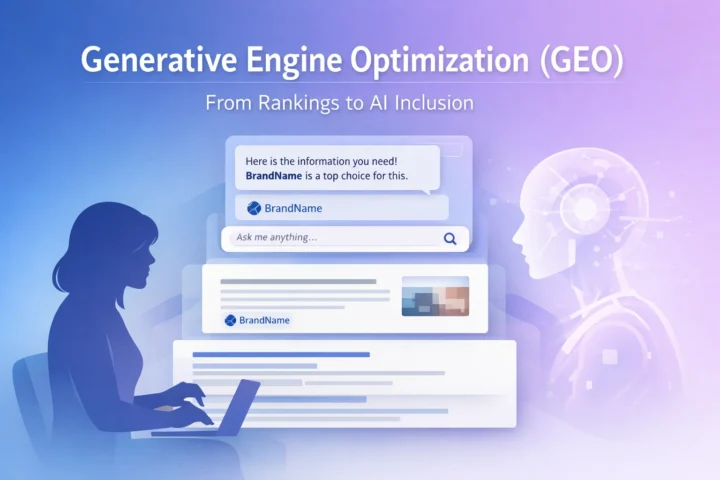
Google search is changing under your feet. The blue links and “rank 1–10” mindset don’t explain why an AI answer omits your brand or quotes your competitor. This Generative Engine optimization (GEO) Guide shows you what to do when large language models and AI overviews become the gateway. You’ll learn how GEO differs from SEO, why it’s necessary now, and how to operationalize it without losing your strategic soul.
What Is Generative Engine Optimization?
To proceed ahead we need to understand what is GEO? GEO is the practice of making your brand, products, and expertise easy for AI systems to find, trust, and quote in their generated answers. Instead of optimizing only for web crawlers and ranking algorithms, GEO optimizes for how generative models ingest, interpret, and synthesize information into a single response.
- Core idea: Design content, data, distribution, and signals so AI can reliably surface your perspective as the best answer.
- Primary targets: AI Overviews, chat search results, answer boxes, copilot responses, and on-device assistants.
- Key levers: Structured, verifiable facts; crisp, intent-mapped explainer content; high-authority mentions; machine-readable context; and distribution that creates model-visible signals.
The Difference Between SEO & GEO
| Attribute | Traditional SEO | Generative Engine Optimization (GEO) |
| Objective | Rank pages for queries | Be cited, summarized, and recommended by AI answers |
| Surface | SERP positions and snippets | AI overviews, chat answers, assistants, copilots |
| Content style | Long-form, keyword coverage | Intent-first, succinct facts, Q&A patterns, citations |
| Signals | Links, technical health, engagement | Authority mentions, structured data, corroboration, freshness |
| Measurement | Rankings, organic sessions, CTR | Inclusion rate in AI answers, citation frequency, assisted conversions |
At its best, GEO is not “new SEO.” It’s a cross-functional discipline spanning content strategy, PR, data architecture, and distribution:
- Information design: Clear definitions, numbered steps, concise claims, and explicit sources.
- Machine readability: Schema, consistent entities (names, IDs), and canonical facts across properties.
- Proof of authority: Third-party coverage, expert bylines, original data, and community validation.
The Advent of GEO and Its Necessity
AI answers compress the journey. If your best material sits behind vague headlines, scattered facts, or inconsistent naming, models will skip you. The result: demand is captured upstream, and your site traffic may fall even while your brand is being “read.”
- User behaviour shift: More answers in fewer clicks; more conversational refinement; less patience for sifting results.
- Model behaviour shift: Preference for concise, structured, corroborated facts; ambiguity aversion; reliance on widely repeated truths.
- Business implication: Visibility becomes inclusion—being woven into the answer, not just listed on the page.
Empirical Evidence Supporting GEO
Across pilots, teams consistently observe that content with explicit claims, clean structure, and third‑party corroboration gets referenced more often in AI responses than sprawling, keyword-stuffed pages. Practical patterns that help:
- Clear fact blocks: “X is Y. Here’s how it works. Here’s the source.”
- Original data assets: Benchmarks, surveys, field studies that others cite.
- Entity consistency: The same product names, specs, and descriptions everywhere they appear.
Intent-Specific Optimization
Generative engines overweight clarity about why a user is asking. Content tailored to intent—how-to, comparison, troubleshooting, purchase—wins inclusion because it maps to the question’s shape.
- Define intents: Catalog top queries and tag by intent.
- Answer shapes: Use formats that match the need—definitions, checklists, pros/cons, steps, tables.
- Avoid drift: Don’t bury the answer under anecdotes or CTAs; lead with value, then invite action.
Domain-Specific Optimization Efficacy
Models learn domains differently. Medical, legal, and financial topics demand stronger citations and compliance language. Developer content benefits from code examples and clear versioning. Local businesses need consistent NAP (name, address, phone) and reviews. Tailor your GEO tactics to the standards and trust signals of your field.
How To Do Generative Engine Optimization?
-
Research topics relevant to your customers
- Map pain-to-outcome: Identify the precise problems your audience wants solved, and the outcomes they measure.
- Mine owned signals: Analyze internal search, support tickets, sales calls, and onboarding questions.
- Listen externally: Track forums, community threads, competitor docs, and Q&A sites to capture real phrasing.
- Build an entity graph: Define people, products, features, and concepts you must be known for; standardize names and relationships.
-
Create Query Intent-Based Content At Scale
- Modular templates: For each intent type, create repeatable blocks—definition, steps, checklist, pitfalls, example, source.
- Programmatic coverage (with guardrails): Generate variants for common modifiers (industry, size, toolset) while enforcing editorial quality.
- Fact sheets: Publish short, canonical fact pages for key entities (product, feature, metric) with stable URLs.
- Comparisons done right: Balanced matrices, transparent criteria, and update timestamps to earn trust and citations.
- Human-in-the-loop: Editors validate accuracy, tone, and claims; models prefer consistent, clean answers over noisy scale.
-
Implement Digital PR Activities With Excellence
- Author authority: Use real expert bylines with credentials and links to profiles (conference talks, papers, patents).
- Third‑party coverage: Pitch original data, frameworks, and case studies to reputable publications and analysts.
- Expert quotes: Offer concise, quotable insights that journalists and creators can lift verbatim.
- Community credibility: Participate meaningfully in niche communities; seeded discussions become training-time citations.
- Knowledge bases: Maintain accurate profiles on high‑trust directories and data sources (e.g., industry associations, standards bodies).
-
Incorporate Structured Data
- Schema.org JSON‑LD: Use Organization, Person, Product, FAQ, HowTo, Article, Course, Event, Review, and Breadcrumb schema where relevant.
- Entity linking: Reference authoritative IDs (e.g., Wikidata QIDs, ISBNs, CAS numbers) to disambiguate.
- Canonical facts: Publish key specs in machine-readable tables or lists; avoid contradiction across pages.
- Versioning and dates: Include “last updated,” version numbers, and changelogs—models favor freshness for dynamic topics.
- APIs and docs: Public, well-documented endpoints and developer docs increase inclusion for technical queries.
-
Informational Queries
- Answer-first: Start with the definition or direct answer in 1–2 sentences.
- Expandable detail: Follow with steps, examples, and pitfalls; keep headings descriptive.
- Visual anchors: Add diagrams or tables that summarize the concept succinctly.
-
Commercial Investigation Queries
- Comparison matrices: Transparent criteria, pros/cons, and use-case fit.
- Contextual recs: “Best for X if Y,” not generic “best overall.”
- Proof: Independent reviews, case studies, ROI numbers with methodology.
-
Navigational Queries
- Unambiguous naming: Consistent brand/product names and abbreviations across channels.
- Landing clarity: Title, H1, and intro match the navigational phrase verbatim.
- Entity presence: Ensure your Organization schema, logo, and sameAs links are clean and current.
-
Transactional Queries
- Frictionless CTAs: Clear pricing, SKUs, stock, and checkout paths.
- Policy clarity: Shipping, returns, warranties—stated in plain language.
- Trust signals: Reviews, security badges, and support options near the action.
Distribute your content
- Owned channels: Newsletter, onboarding flows, in‑product tips—drive initial engagement and citations.
- Syndication: Publish excerpts on partner sites and platforms with canonical links and consistent facts.
- Communities: Share practical slices (checklists, templates) where your audience already solves problems.
- Creator enablement: Provide media kits, quotable stats, and embeddable assets to increase organic referencing.
- Documentation hubs: For technical products, centralize guides, SDKs, and FAQs with stable URLs.
Embrace multimedia
- Video summaries: 60–180 second explainers mirroring your written “answer-first” format; include transcripts.
- Audio insights: Short podcasts or voice notes that distill frameworks; publish show notes with key claims.
- Interactive tools: Calculators, checklists, and diagnostics that generate shareable results.
- Accessibility: Alt text, captions, and transcripts improve both usability and model ingestion.
Leverage social media
- Atomic insights: Threads and carousels that encapsulate one useful idea at a time; include the canonical link.
- Live learning: Host AMAs and office hours; harvest questions to feed your intent map.
- Signal amplification: Coordinate posts from execs, experts, and customers to create multi-node authority.
- Feedback loops: Watch which explanations get reshared; turn those into evergreen pages.
Optimize your website’s AI readiness
- Performance: Fast TTFB, clean HTML, and minimal render-blocking scripts reduce parsing friction.
- Crawler clarity: Sensible robots rules, sitemaps, and consistent canonicalization prevent duplication and confusion.
- Content primitives: Use clear headings, lists, and tables; avoid burying key facts in dense prose or images.
- Entity hygiene: Unique, stable URLs per concept; consistent naming; no silent redirects that break references.
- Freshness discipline: Batch updates with visible timestamps; maintain changelogs for living documents.
- Verification cues: Link out to sources; cite methodologies; publish editorial standards and author credentials.
Conclusion
Generative Engine Optimization (GEO) guide is no longer optional—it’s the bridge between being found by search engines and being featured by AI-driven answers. By aligning your content, structure, and distribution with the way generative models understand and deliver information, you ensure your brand’s voice is present where decisions are made. In a world where visibility is shifting from rankings to AI inclusion, mastering GEO is the key to sustaining relevance, authority, and impact.