
Summary
User browser interaction determines how information is accessed online. This article focuses on the meaning and operation of searching Google or entering a URL in the context of everyday browser usage. It includes:
- When to search Google versus typing a URL
- Main distinctions between discovery and direct navigation
- Role of AI and predictive search in shaping user behaviour
- Common problems with the search bar and their solutions
You’ve probably already done it without even realising when you opened a browser, clicked on the address bar, and hesitated as you saw the words ‘Search Google’ or ‘type a URL’. In that quick moment, you decide how your internet journey starts. Sometimes you are already clear about the destination, and sometimes you are just seeking answers, choices, or inspiration.
This very simple decision affects how quickly you get the information and which brands you come to know during the process. In this blog, we will discuss how search and direct navigation can turn your normal browsing into something more intelligent and efficient.
What Does “Search Google or Type a URL” Represent?
This sentence basically shows how browsers currently operate.
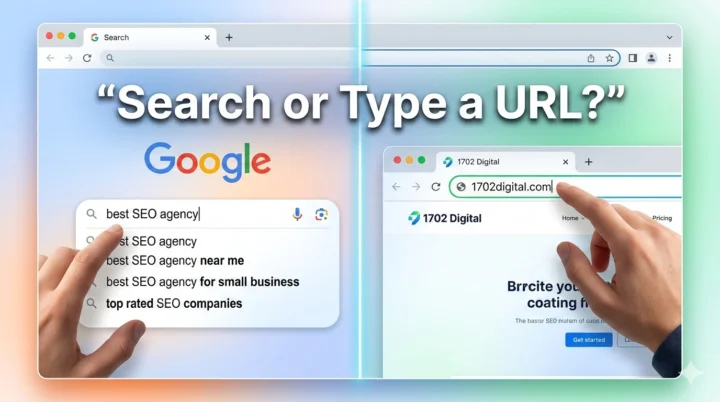
The address bar, also known as the omnibox, serves two functions in one tool. When users enter a search query or an address, the browser tries to infer their intent.
If the input is a keyword, the browser will treat it as a search. But if it looks like a web address or simply a brand name, then it will be direct navigation. It is for this reason that, by default, users can search or enter a website name in the same place without switching tools.
Over the years, a combination of these behaviours has blurred the distinction between searching and navigation. What were two separate actions have now been transformed into a single, intelligent interaction.
Situations Where Searching on Google Is the Right Choice
When the destination is not yet defined, it is best to use Google search. It helps one learn, compare, and decide what information is useful for them.
People select Google Search when they want to:
- Look for other options or possibilities
- Compare different products, services or even brands
- Read reviews, follow guides or get explanations
In fact, according to Statista, Google accounted for around 90% of the worldwide search engine market share, making it the primary gateway to online discovery. Appearance matters here the most. If users have never heard of your business, they will find you through search.
Situations When Typing a URL Is the Right Choice
It’s crucial to type a URL quickly and confidently. Therefore, if users know exactly where they are going, then adding another step of searching is just a waste of time.
This method fits perfectly when:
- The website is one that you trust or use quite regularly.
- You are going back to the branded or bookmarked page.
- Pasting a landing page link.
When users search and type the URL accurately, they avoid ads, competitors’ results and other distractions. From a brand’s perspective, this behaviour is a signal of trust and recall. People do not need to search for the brand; they can just click on the desired website.
Search Google vs. Type a URL: What Are the Differences?
Users can get confused between searching on Google and typing a URL because the main difference is not which option is better, but what the user intends to do. User intent decides which method is better. If the user wants to go to a specific place, typing the URL is the preferred method. However, if the user wants to explore the available options and is unsure of the destination, the option is to search.
Typing a URL is fast and direct when a person knows where they want to go. In this case, it does not distract your mind and takes you directly to your page. On the other hand, Google search is more of a discovery tool. It allows users to find more choices, compare results, and discover information that they weren’t necessarily looking for.
It is essential not only for users but also for businesses to understand this difference. Brands that are easily found through search will make the exploration phase easier. In contrast, a strong brand recall will reduce the need for search and encourage direct visits, where users are more likely to type a URL than search.
| Factor | Google Search | Typing the URL |
| Discovery Potential | Very high, shows a lot of choices to users | Extremely low, only the site that the user wants. |
| Accuracy | The results are ordered and filtered | If the URL is correct, then the destination is exact. |
| Best Used When | Learning, researching, or comparing in general | When visiting a familiar or reliable website. |
| Impact on Brands | It is a source of brand awareness and visibility | It is an indication of brand trust and recall. |
| User Behavior | Users make use of search or type URL queries | Users do not make use of the search at all. |
| Speed | It takes a bit more time due to the listing of results | Faster when the destination is known. |
The Impact of AI and Predictive Search on the Consumer’s Choice
AI has profoundly changed how people engage with search bars and browsers. Predictive search no longer waits for users to finish typing a query; instead, it predicts intent based on search patterns, past behaviour, and popular trends. Suggestions appear as users type; thus, they can get relevant details faster.
This is why we have witnessed a decrease in the need to write search queries or exact website addresses fully. A large number of users are now relying on these recommendations to make their clicks, thereby speeding up their decision-making and making navigation easier.
Most Common Issues with the Search Bar
Despite modern browsers feeling natural, the search bar can sometimes be quite confusing. A user might enter either a search or an address and expect to land on a website. Instead, they are redirected to a search results page. This mix-up is mainly due to how the browser interprets the user’s input, not user error.
Some very common issues might be:
- URLs could be confused with search queries because of typos or missing extensions
- The browser is using a default search engine that was not intended
- The autocomplete suggestions give preference to entries that are outdated or irrelevant
So, Which One Should You Use?
The correct answer may vary depending on the purpose.
If the purpose is exploratory, research, or comparative, a Google search is the most suitable option. If the purpose is speed and direct access, then typing a URL makes more sense.
From a business perspective, they need to be searchable when potential customers look for them and memorable enough that customers remember them easily. Striking that balance is what solid digital marketing services are all about. At 1702 Digital, we focus on helping businesses strengthen their presence across search and build recognition to drive more direct visits. Our results are not just traffic but meaningful engagement that supports long-term growth.
Also Read – All Google Search Operators Explained with Examples (Basic to Advanced)
Google December 2025 Core Update: What Google Is Rewarding Now
Understanding Google Core Updates, AI Search, & Visibility
People Also Search For (PASF): Meaning, Importance & SEO Strategy for Intent-Driven Rankings
FAQs
1. What is Google URL search?
With Google URL search, a person can enter keywords or a website address in the same browser bar. The browser determines what the user wants and either takes them to search results or to a webpage directly.
2: How does predictive search improve my browsing experience?
Predictive search determines what the user is looking for and thus offers relevant query suggestions and destinations. In this way, the user’s typing work is eased, and getting the information becomes faster.
3: Can AI help me find competitors or trending content through search suggestions?
Indeed, AI-based search suggestions display trending queries, popular topics, and related brands to the user as soon as they start typing. Such knowledge of market demand and competitor visibility is priceless for anyone.
4: How does Google determine which results to show first?
Google selects listings for the search results page through a ranking process that evaluates factors such as relevance, content quality, authority, and signals of user intent. The lessons of successful SEO campaigns lie in these elements.