What is URL Structure? Effects on SEO Rankings and Best Practices
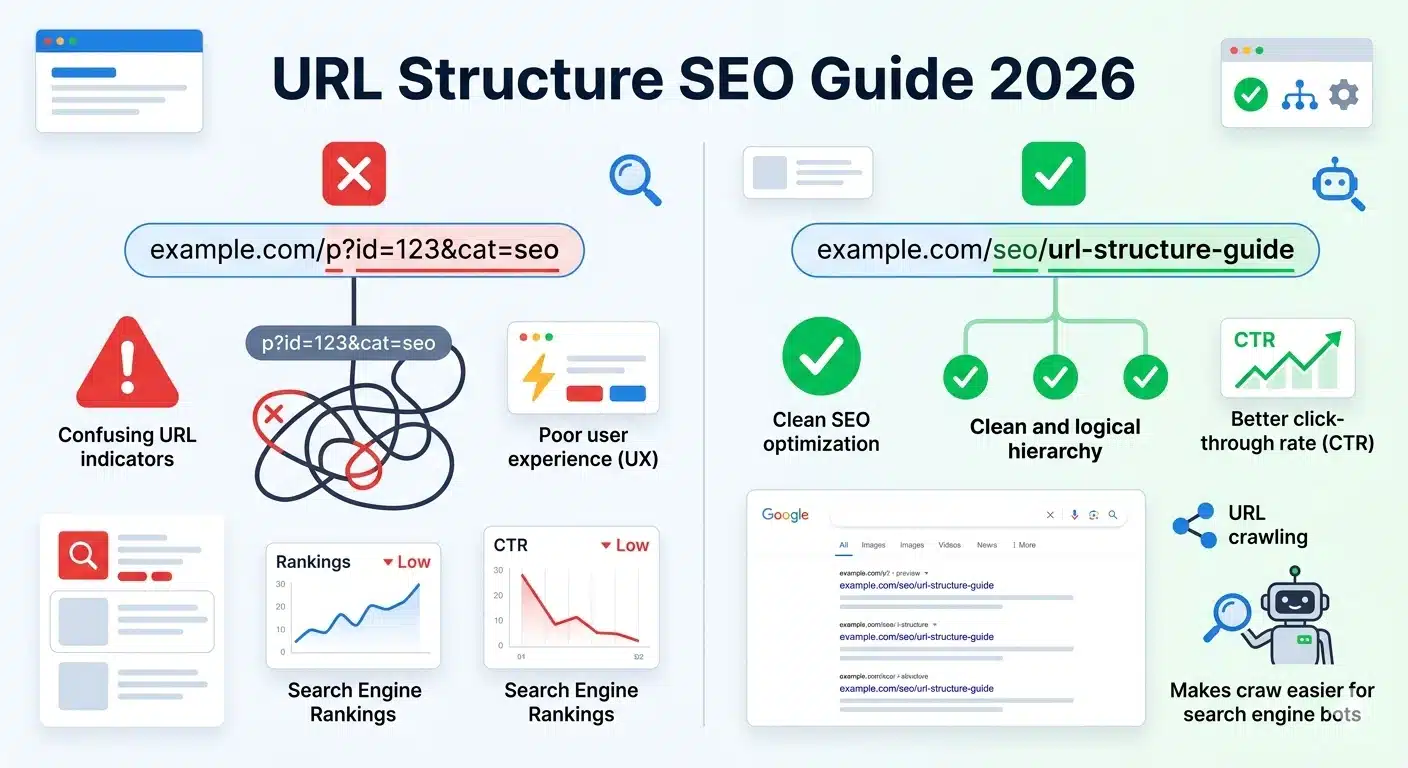
Table of Contents
Confused about how URLs affect the visibility of your website? In this guide, we will explain everything you need to know regarding:
- What is the notion of URL structure in relation to SEO, and why should you care
- How URLs affect rankings, crawling, and usability
- Tips and useful resources to enhance the performance of your website
Not only is a clear URL structure aesthetically pleasing, but it is also considered a ranking factor and a usability feature, and it generally sets the tone for the first impressions users get from pages. Depending on whether you operate a personal blog or a corporate site, understanding the intricacies of URL structure SEO can help you significantly boost the organic traffic to your site.
URL Structure Definition in SEO
The term ‘URL structure’ pertains to the structure and design of a website’s address. This consists usually of the protocol used (HTTPS), the domain name, and finally, the path.
Example of URL structure: https://www.example.com/seo/url-structure-guide
When it comes to SEO, a good URL is usually short and uses keywords to make the purpose of the page easier to comprehend by both humans and bots.
This is important because an effective SEO URL structure allows users and search engine bots to easily understand the nature of the page without any difficulties. According to Google Search Central, simpler URLs that include words work best.
SEO Best Practices with URL Structure Optimisation
- Length and Readability: Shorter URLs are easier to read and to distribute. Research performed by Backlinko (2024) revealed that shorter URLs can work better when showing up in the top result on Google.
- Keyword Usage in URLs: Keyword insertion in URLs improves their relevance. Do not use too many keywords in URLs.
- Hyphen Usage vs. Underscore Usage: It is recommended by Google to use hyphens in a URL in order to separate words since search engines process them faster.
- Dynamic URL Avoidance: Dynamic URLs can be overloaded with parameters (?id=123&cat=456), making indexing impossible.
- Organisation and Structure: Arrange URLs according to your website organisation. Example: /blog/seo/url-structure. Optimising URLs requires a very careful approach, since it should be a balance between simplicity and scalability.
Effect of URLs on SEO Rankings
It is a known ranking signal, but its significance cannot be compared to the one of high-quality content and backlinks. However, it still plays a considerable supportive role.
- Inclusion of keywords: Pages with keyword-rich URLs can give an idea of what the page is all about
- Efficiency of bots: URLs that look neat are easier for bots to index
- Increased CTR: Neat URLs appeal more to users
The use of URLs is beneficial for CTR, which means positive effects on the rankings. Consistency should be kept during URL optimisation for SEO purposes across your website.
Impact of URL Structure on UX Performance
It is vital for SEO since having a great UX leads to:
- Improved readability: People will immediately see why the page was created just by glancing at the URL
- Enhanced trust: Neat URLs gain more trust from people
- Simpler sharing: URLs that look neat are much easier to share
Compare these two URLs:
example.com/p=123?id=seo or example.com/seo/url-guide
Which one looks better? Clearly, the second one wins hands down. A good SEO URL structure increases both usability and engagement.
Best URL Optimisation in SEO Tools for Structuring URLs
- Google Search Console: It is helpful for identifying issues related to indexing and URLs.
- Screaming Frog SEO Spider: A tool to conduct a complete audit of URLs and find any anomalies.
- Ahrefs Site Audit: A tool that helps you get an idea of the quality of URLs and improve them.
- SEMrush: Helpful for analysing URLs and keywords.
- Yoast SEO Plugin for WordPress: This is very helpful when editing URLs.
All the above tools are extensively used by professionals providing SEO services in India as well as worldwide.
Recommendations from Google for SEO-friendly URL structure
Some of the guidelines related to URL optimisation in SEO have been provided by Google:
- Don’t use long numeric IDs; rather, use words that people can understand.
- Remove any unwanted parameters and session IDs from your URLs.
- Always use the HTTPS protocol in your URLs.
- Make sure you only use lowercase letters in URLs.
- Avoid creating duplicate URLs for the same piece of content.
Google Search Central has recommended certain guidelines for SEO in 2026. The significance of following these rules cannot be underestimated.
Why URL Structure in SEO Is Still Important In 2026?
SEO has come a long way since the advent of AI and machine learning technologies. However, that does not mean that traditional SEO factors, such as URL structure, do not play an essential role in optimising your website. Not only will your website gain better exposure online with proper SEO URL structure, but it will also improve the user experience.
Are you interested in optimising your website’s SEO? Contact 1702 Digital, a reliable provider of SEO services in India, to learn more about optimising your website for better performance and rankings in 2026.
Frequently Asked Questions (FAQ)
1: What are the qualities of an excellent SEO friendly URL?
An SEO-friendly URL should be concise and descriptive, with relevant keywords included in it.
2: What is the role of a mobile-responsive URL in SEO?
The mobile-responsive URL is one that leads to creating a positive user experience and a lower bounce rate, and thus aids SEO indirectly.
3: What are the canonical tags, and what do they mean?
Canonical tags are used by search engines to indicate which of all the same URLs is the original.
4: What is the impact of URL structure on SEO?
It directly impacts the crawling ability and relevancy of content with regard to keyword URLs. Without a proper URL structure, search engines find it challenging to analyse the contents of the webpage.
Like What You Read?
Have an Idea and Want to Build Something Together? Contact Us Now
4 Best SEO Plugins for WordPress in 2026
Fed up with trying to make your WordPress website stand out? Then you need the appropriate software kit. Although great…
Read more →
How Content Chunking Improves SEO, AI Visibility & User Experience?
The way content is structured has mattered for readability. But with AI-driven search now reshaping how information is discovered, structure…
Read more →
10 Best Shopify SEO Tools Every eCommerce Needs To Optimise The Store
There are challenges and tasks to take your Shopify store live and to rank it. With the number of online…
Read more →