
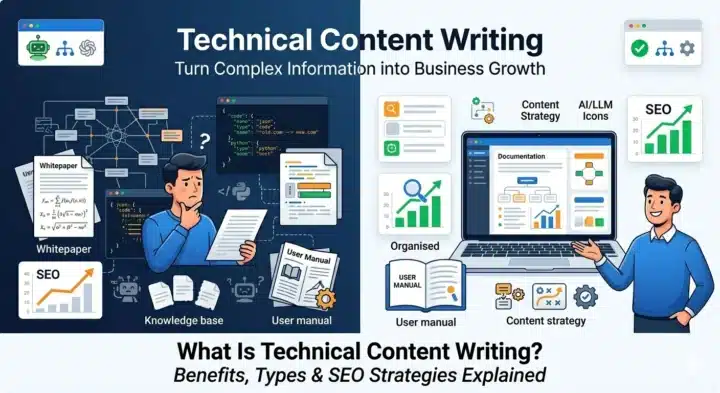
Technical content writing helps convey information to its intended recipients effectively. It helps businesses communicate clearly, improve user experience, and build authority. In this blog, we will discuss:
- What technical content writing means and why it matters for business
- How to write technical content and the kinds of technical documents they produce
- How it benefits the business
- Practical ways to create valuable content for conversions and lead generation
The potential customer lands on your website. They have done their research and like what you offer. Then confusion kicks in. Your product is amazing, but your content isn’t. The information is messy, the explanations are vague, and you just fail to address all those doubts floating around. In an instant, they leave your site—no inquiry from them, no conversion. And you miss yet another opportunity because you underestimate the importance of clear and professional technical content.
Here is what most businesses ignore when it comes to their online performance: clients don’t buy the product alone. What they actually need is clarity, knowledge, and the confidence that buying that product will never be a mistake. And that is where the importance of technical content writing lies.
Technical Content Writing: An Introduction
In this section, we will focus on what technical content writing is. To put it simply, it is transforming complex, specialised data into an easy-to-read form for the intended audience. Good knowledge about the subject and the art of conveying the message effectively are the two important aspects of technical content writing. You might think of it as making complicated things simple, and simple things compelling.
The need for good technical content is growing fast. According to research reports, the global technical content writing services market size stood at around USD 22.63 billion in 2025 and is forecast to reach USD 35.63 billion in 2032 with a CAGR of 6.7%.
Examples of Technical Writing
Technical writing may not be as prevalent as you think. Here are some everyday examples of technical writing:
- User Manuals and Product Guides: Like the ones for IKEA furniture or your smartphone.
- Application Programming Interface (API) Documentation: Used for building software.
- White Papers and Research Reports: These documents are used in B2B sales efforts.
- Standard Operating Procedure (SOP): a document that guides employees on how to perform tasks.
- Case Study Analysis: A narrative account of the analysis of past experiences to create proof.
- Technical Blogs: SEO-based blog posts that provide information and increase domain authority.
Every one of these examples of technical writing has a different use, but they all share one thing in common – clarity.
Technical Writers’ Responsibilities and Job Duties
A technical writer does not just ‘write’. It is one of many responsibilities of a technical writer. Let us find out more about what it entails to be a good technical writer:
- Research and Information Collection: Interviewing subject matter experts, reading specifications, and analysing user behaviour.
- Audience Analysis: Audience analysis and customisation of the content based on it.
- Structuring of Content: Structuring of content using frameworks and hierarchy.
- Drafting and Editing: Drafting and editing of quality and error-free copies according to the tone of the brand.
- Collaboration: Collaboration with departments such as engineering, design, product management, marketing, and other departments.
- Content Update: Updating the content with any new developments.
All these considerations will be addressed when you opt for technical content writing services.
Types of Technical Writing
Technical writing covers many different areas. The main categories are:
- End-user Documentation: End-user guides, FAQs, helpdesk documents, and user manuals.
- Developer and API Documentation: Detailed technical documentation for software engineers.
- Scientific and Medical Writings: Clinical trial reports, scientific articles.
- Legal and Compliance Writing: Contracts, compliance guides.
- Business & Process Documentation: Standard Operating Procedures, flowcharts.
- Marketing-Oriented Technical Writings: The best of both worlds – technical writing combined with marketing content services.
Technical Content Writing Benefits
Not yet convinced of the usefulness? Unsure of how to write technical content and reap its benefits? Paying for technical content is a worthy investment in your company and offers several benefits. Here’s what it could do for your brand:
Establish Authority and Credibility
People trust information they see in writing, especially when it comes from an authority. With accurate, informative technical content, you can build your brand’s credibility.
Draw in the Target Audience
Not all website visitors are valuable. Technical content helps draw in people searching for relevant information. They typically intend to make a purchase.
Sells Your Product Before Your Sales Team Does
While your employees are sleeping, your content keeps selling your product. That’s all it takes to convince someone of the value of your technical content writing services: provide a well-crafted white paper, case study, or product guide.
Saves Support Time
With comprehensive documentation and FAQs, there would be less reliance on customer support teams. This leads to reduced support time for customers’ issues.
Ensures Consistency within the Team
On the technical side, technical documentation is necessary to ensure consistency.
Offers Longevity
Whereas advertisements would continue only as long as you budgeted them, content builds momentum. One optimised piece of technical writing will drive traffic and leads, and can even become authoritative over the course of years.
Strategies for Effective Technical Content Writing
Knowing how to write technical content that really works needs more than just expertise:
1. Understand who you are writing for
Figure out who your audience is; for example, are they engineers, top management, or simply your customers? The level of knowledge that your target audience already has will influence your vocabulary choices and the level of detail.
2. Start with an outline
First, make sure to create a proper outline. Things like headings, numbering, bullet points, and visual aids work exceptionally well to capture your reader’s attention immediately.
3. Use simple language
‘Technical’ doesn’t have to mean ‘complicated’. Make clarity your top priority when writing. Use short sentences and active voice.
4. Don’t forget SEO
Find out which keywords your audience frequently uses and incorporate them naturally into your content. But don’t overdo it with keywords: Google will penalise you, and your readers will not be satisfied.
5. Use an expert’s help
Always have a subject-matter expert check your content. Being accurate is a must. Get in touch with 1702 Digital for more information on what technical content writing is.
6. Thoughtful repurposing
A single white paper can be turned into several blog posts, a LinkedIn carousel, an infographic, or even a webinar. Turn everything you have into content marketing resources.
7. Monitor and refine
Track the performance of your content, how long people read it, the bounce rates, the number of leads generated, and the places where it ranks. Utilise this data for ongoing enhancement.
Technical Writing for Business Growth: Why Is It Important?
The following needs your attention: technical writing is much more than just being necessary these days.
Consider this: the global market for digital content marketing services is expected to reach USD 117.51 billion by 2034, up from USD 32.26 billion in 2024. This means that companies that create high-quality digital content today will reap the rewards for many years to come.
In addition, 82% of customers form positive perceptions of brands through custom content. Not only do they learn about your product or service, but they come to love it!
If your business deals with technical products or solutions, content can be your first point of contact. In other words, good content works like magic when it comes to closing sales. At 1702 Digital, our technical content writing services are built on this understanding. We don’t just write, we engineer content experiences that move your audience from awareness to action.
What are Good Topics for Your Technical Blog Posts and Guides?
Selecting topics might be the biggest mistake companies make. Try following this proven topic selection formula:
- Start with Customer Pain Points: Whatever questions your support team answers daily are your upcoming blog posts.
- Analyse Search Queries: With Google Search Console, Semrush, and Ahrefs, find out which keywords with high search volume and little competition your target audience uses in search queries.
- Mind Your Competitors’ Keywords: How does your competitor rank for certain keywords? You can exploit this opportunity to beat them.
- Be Up-to-Date with Industry News: Every development, whether it is the introduction of new regulations or a new product, presents another opportunity to create high-quality content.
Conclusion
With knowledge of what technical content writing is, it is crucial to recognise that the real strength is in knowing how to do it right. This is all about precision, consistency, and targeting your readers.
If you need to prepare comprehensive product documentation or authoritative whitepapers, hone your technical content skills, or need content marketing services that rank well in search engines, contact us at 1702 Digital.