Google December 2025 Core Update: What Google Is Rewarding Now
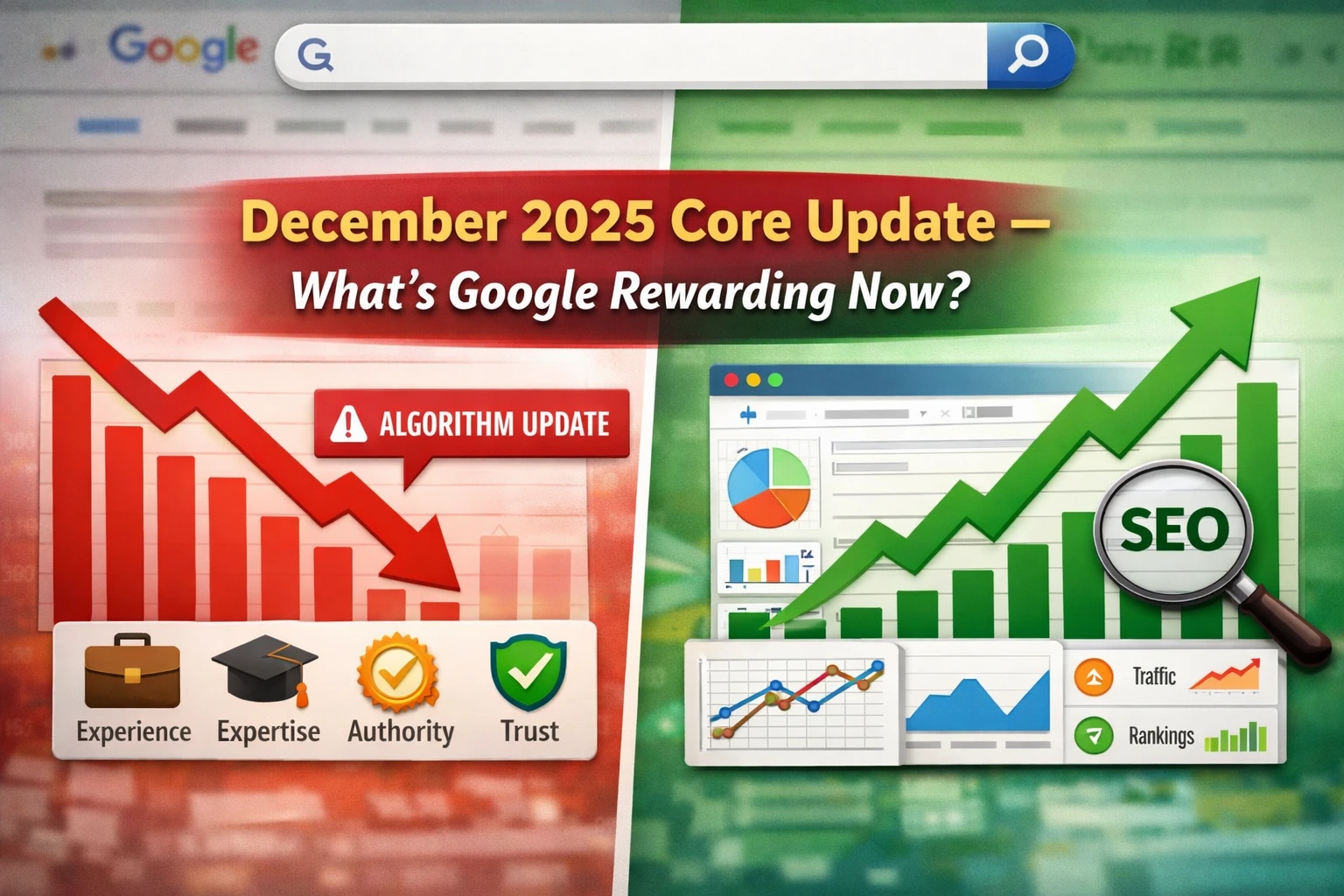
Table of Contents
Google has done it again! Just when everyone was finishing the year-end recap, reviewing their performance reports and thinking ahead, Google dropped their December Core Update. It has created numerous twists and turns, making it challenging for marketers to keep up. Rankings, traffic graphs, and SEO conversations all changed overnight. Some sites experienced unexpected success, while others struggled to understand what had happened.
Rather than viewing this update as chaos, we should view it as a sign of progress. Each core update provides marketers with insight into how Google’s search engine is evolving, as well as a more profound understanding of what is valued most in content today.
This blog will help you understand what has changed, who this update has impacted the most, and, more importantly, which specific SEO strategies or tactics are most effective moving forward.
What Is the December 2025 Core Update?
The latest update is one of Google’s regular operations aimed at enhancing search result quality. Google tweaks how it evaluates and ranks different types of content as part of the update. Unlike small changes that only impact one factor, a core update changes the entire ranking system of Google.
This Google core algorithm update didn’t target any one industry or tactic. Instead, it reviewed content quality, relevance, trust signals and overall user satisfaction across the web.
In simpler terms, Google didn’t “punish” websites; it re-ranked them.
Timeline: When will the December 2025 Core Update roll out?
The December Core Update was the last major Google algorithm update in a year that witnessed steady and consistent changes. Throughout 2025, Google has released several updates aimed at improving the quality of content and search results. The March 2025 core update was the most significant one before December, with a greater focus on intent-based, in-depth content. Throughout the year, Google made smaller adjustments that reinforced the same quality-based signals.
Google officially announced the core update at the beginning of December and gradually implemented it over several weeks. Several SEO tracking tools were quick to spot ranking fluctuations and reported changes in the rankings that seemed to particularly affect highly competitive fields, such as health, finance, and e-commerce. It was common to see your traffic fluctuate as Google re-evaluated websites not just for individual pages but on a more extensive, site-wide level.
Here is a simple December 2025 Core Update rollout timeline:
- Early December: Google officially announced the update.
- After 2-3 Weeks: Worldwide, regional, and language-specific rollout.
- End of December: Rankings became stable, just in time for the end-of-year evaluations.
The volatility was at its peak during the first few days. The December Core Update most likely caused any traffic changes your website experienced in the middle of the month.
Who Was Impacted the Most?
The December Core Update made a difference in several industries, but below are the types of websites that saw changes:
Websites That Saw Drops
- Thin or surface-level content
- Pages which only focus on ranking on search engines and do not satisfy users
- Websites with weak E.E.A.T. (Experience, Expertise, Authoritativeness, Trustworthiness)
- Outdated content that does not reflect the current value of search intent
Websites That Benefited
- In-depth, original, and user-first content
- Clear author credentials and trustworthy sources
- Well-developed internal linking, topical authority
- Pages that genuinely solve users’ problems
If your website has gained more visibility, it’s probably because Google considered your content more valuable than the competitors’ after the December 2025 Core Update.
What This Change Means to Businesses and Brands
With organic search accounting for nearly 53.3% of overall website traffic, even small ranking changes following the December Core Update can significantly affect business performance. For brands that rely heavily on organic search traffic, this update serves as a reminder that SEO requires ongoing effort and attention. The quality of content, user experience, branding, and the technical health of your website all contribute to how Google perceives your website, which, in turn, fosters a proactive approach.
Those who regard SEO as a one-time activity are the ones who will struggle to regain their rankings after a core update, whereas those who invest in a long-term digital strategy are the real winners. They not only recover after the updates but also have new opportunities for growth after every major update.
Need Help after Struggling With the Update?
If the latest Google core update negatively impacted your rankings, it doesn’t mean you have to start over completely; it simply means that you need to refine your strategy.
Here’s 1702 Digital, a determined, data-driven digital marketing company that can be your saving grace. We provide a wide range of digitally-oriented services and help businesses stay on track with mobile and desktop web algorithms. We focus on long-term growth by combining expert SEO services, content strategy, performance marketing, branding, and analytics, aligning with evolving trends.
Next Steps After the December 2025 Core Update?
After implementation, it is important to evaluate the quality of the content on your site. This is not about rewriting every single thing. It is rather about identifying gaps where the content can be expanded or explained more effectively to align with the searcher’s intent. You often get better results by upgrading the existing pages than by creating new ones. Providing detailed author information, refreshing data, internal linking, and offering real-world examples are ways to improve your site in Google’s eyes after the December core update.
Conclusion
If there is one thing to learn from the December Core Update, it is that Google no longer makes guesses about which content deserves ranking; it is aware. After a year of the algorithm continuously changing, this update rewarded only those websites that consistently provided clarity, relevance, and valuable content.
The changes that many websites experienced were not abrupt. It was the accumulation of effects. Brands that had implemented content strategies in 2025 were still effective, while outdated ones encountered challenges. That certainly clarifies one thing: SEO success nowadays is all about quality over time rather than last-minute optimization.
Like What You Read?
Have an Idea and Want to Build Something Together? Contact Us Now
4 Best SEO Plugins for WordPress in 2026
Fed up with trying to make your WordPress website stand out? Then you need the appropriate software kit. Although great…
Read more →
How Content Chunking Improves SEO, AI Visibility & User Experience?
The way content is structured has mattered for readability. But with AI-driven search now reshaping how information is discovered, structure…
Read more →
10 Best Shopify SEO Tools Every eCommerce Needs To Optimise The Store
There are challenges and tasks to take your Shopify store live and to rank it. With the number of online…
Read more →